Updated on: 11 November 2026
US exchange year and NCAA eligibility
A US exchange year makes the Division I 10/7 grade rule apply to you. The year does not start your five NCAA years. Each state decides if you may play school sport.
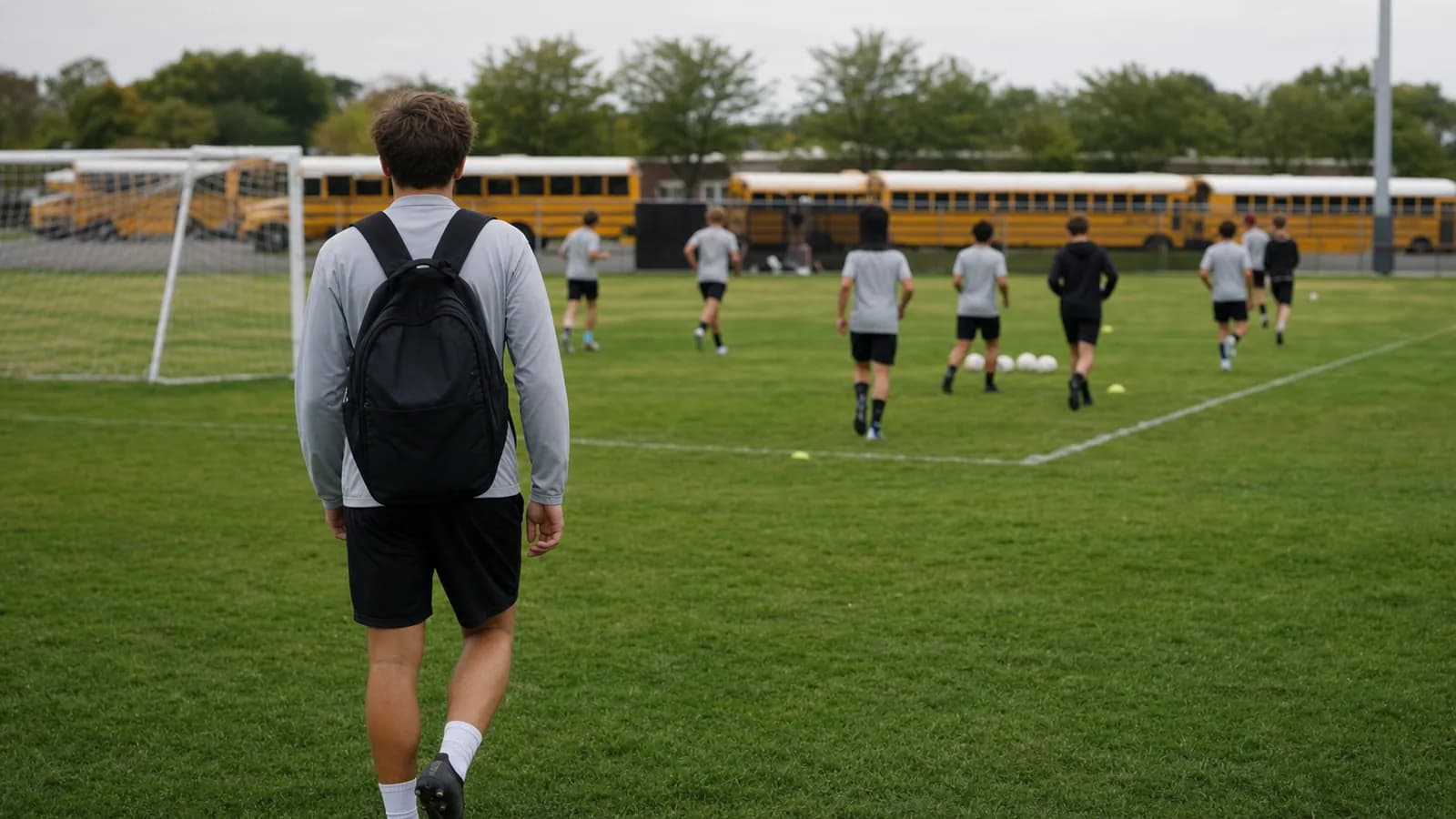
Image: AI-generated.
Exchange year in 3 key points
The 10/7 rule applies after US school
Core courses are the school subjects the NCAA counts. The Division I 10/7 rule sets how many you need before your seventh semester. It applies to anyone with part of secondary school at a US school. That wording covers an exchange year.
NCAA clock starts with study or age 19
In Division I, you have five years to play four seasons. The NCAA five-year clock starts with full-time study at a university or college. It can also start with the academic year after your 19th birthday. A US high school is not a university or college. So during an exchange, only your age can start the clock.
Each state decides about school sport
The J-1 visa is a US exchange visa. Its federal rules allow school sport if the district and state sports authority agree. Michigan lets students from approved programs play one year on the first team. Most other exchange students in Michigan may only play on lower teams.
Division I's 10/7 rule after an exchange year
The 10/7 rule is a deadline in NCAA Division I. Division I is the top level of US college sport. Core courses are the school subjects the NCAA counts.
You need 16 core courses in total. Before your seventh semester of secondary school, you must finish 10 of them. Of these 10 courses, 7 must be English, mathematics or science.
Bylaw 14.3.1.1.1 exempts students whose school records come only from outside the USA. The NCAA also writes who must meet the rule. It is anyone who spent part of secondary school at a US school.
The NCAA does not name exchange students. So plan as if the rule applies to you.
The 10 courses before the seventh semester count, and so do their grades. They decide if you may compete in your first university or college year. Later courses cannot replace them.
Your exchange may fall in your tenth or eleventh school year. Then take English, mathematics and science in the USA and keep your grades up.
Records from both schools for the Eligibility Center
The NCAA Eligibility Center checks your school grades for Division I and II. It checks courses from an NCAA-recognized US high school by US rules. It checks your home records by the standard for your country.
So you send two sets of records. Your home school records start with the ninth school year. You send them in the original language, with a certified word-for-word English translation.
A transcript is the official list of your courses and grades. The US high school must send its transcript. It may send it itself or through an admissions office.
Register with the Eligibility Center before or during the exchange year. Then both schools send to the same account. Ask the US school how it sends records abroad.
Some school-leaving exams come late, such as the Abitur or the Baccalauréat. A late exam does not make you miss the Division I core-course deadline.
The five-year clock and your 19th birthday
In NCAA Division I, you have five years to play four seasons. The NCAA calls this time the five-year clock.
The clock starts with your first full-time term at a university or college. It can also start with the academic year after your 19th birthday. Whichever comes first starts the clock.
Bylaw 14.02.4 counts only institutions of higher education. A US high school is not such an institution. So a high school year does not start the clock.
The exchange may delay your school-leaving exam. Then you may turn 19 before you finish school. A 19th birthday before September 1 starts the clock that August. This holds even if you are not at a university or college.
The NAIA is the second US college sports association next to the NCAA. It counts only university or college terms with at least 12 credit hours. So a high school year costs you no NAIA time either.
State associations decide about the school team
The J-1 visa is the US visa for exchange programs. Its federal rules are in 22 CFR 62.25. They allow school sport if the local school district and state sports authority agree.
Each state authority sets its own conditions. The MHSAA is Michigan's school sports body. Varsity is the school's first team.
The MHSAA gives J-1 and F-1 students a spot on varsity. In most cases, this goes through an approved exchange program.
Students from approved programs play varsity one year and sit out the next. The MHSAA calls this rule Play One, Wait One.
Other international students in Michigan get no varsity spot. After about one semester, their school may let them play on a lower team.
Before you accept a placement, ask the exchange organization and the host school. Find out if you may play your sport, at what level and from when.
J-1 sponsors may not place you by sport
A J-1 exchange runs through a sponsor. A sponsor is an organization that the US State Department approves.
Rule 22 CFR 62.25 bans sponsors from placing students by athletic ability. This holds no matter who asks for it. A sponsor that offers you a school for its team breaks this rule.
The J-1 school program has an age limit. Students must be 15 to 18 and a half at the start.
Students who have finished no more than 11 school years can also join. The program lasts one or two semesters. Former J-1 or F-1 students at a US school cannot join.
The F-1 visa is the US student visa. At public high schools, an F-1 student may stay 12 months at most. The student must pay the school district the full cost of schooling.
No school may waive this cost. Private schools have neither limit.
Public scholarships for a free exchange year
The NJCAA is the junior college association. Athletic scholarships from the NCAA, NAIA and NJCAA pay for a university or college. They never pay for high school.
A public high school must charge an F-1 student the full cost. A private school sets its own fees and any aid.
Some governments fund exchange scholarships. The Bundestag is the German parliament.
The Bundestag and the US Congress run the Parlamentarisches Patenschafts-Programm, or PPP. This program pays for an exchange year in the USA.
The application window for 2027-28 has already closed. The deadline was September 11, 2026. The Bundestag expects applications for 2028-29 to open in May 2027.
Ask your education ministry or recognized exchange organizations about public programs in your country.
Rules with and without a US exchange year
Each row compares one rule for two athletes, as of November 2026. One has school records only from home. The other has a US exchange year.
| Rule | School records only from home | With a US exchange year |
|---|---|---|
| Division I 10/7 rule | Does not apply | Applies: 10 core courses before semester seven, 7 in English, mathematics, science |
| Records for the Eligibility Center | Home records from year nine, with certified translation | Home records plus the US transcript, sent by the high school |
| Division II | 16 core courses, core average 2.2 | The same, and the NCAA names no deadline |
| NCAA five-year clock | Starts at first university or college enrollment, or after your 19th birthday | The same, and the high school year does not start it |
| NAIA | Counts terms at a university or college with at least 12 credit hours | The same, and the high school year costs nothing |
| School team in the USA | Not applicable | The state association decides. In Michigan, first-team play goes in most cases through approved programs, for one year |
After a US exchange year, Division I checks your English, mathematics and science courses. It counts the ones you finished before your seventh school semester.
Exchange year: rules and application steps
An exchange year affects the NCAA grade rules and the five-year clock. You collect records from both schools. Then you fit the year into your application plan.
Rules with source and check date
Application steps with their dates
Common questions about athletic scholarships in the USA
Does the Division I 10/7 rule apply after an exchange year in the USA?
Does an exchange year in the USA count against NCAA eligibility?
Can exchange students play high school sports in the USA?
Are there athletic scholarships for high school students in the USA?
How can I do an exchange year in the USA for free?
Does a J-1 exchange year help you find a US college team?
Does playing for a US high school team affect my NCAA amateur status?
Should I choose a J-1 or F-1 visa for a US exchange year?
More guides on athletic scholarships
Sources
Each figure comes from one of these sources. If no source reports a figure, we do not estimate one.
- NCAA, International Student Initial Eligibility Requirements (11 November 2026)
- NCAA, 2026-27 Division I Manual, Bylaws 12.6, 14.02.4, 14.3.1.1 and 14.3.1.3.1 (five-year period, collegiate institution, core courses, time limit) (11 November 2026)
- 22 CFR 62.25, Secondary school students (federal rules for J-1 school exchange) (11 November 2026)
- Michigan High School Athletic Association, International Student Enrollment and Athletic Eligibility (9 June 2025) (11 November 2026)
- NCAA, Division I and Division II age-based eligibility rules (11 November 2026)
- Deutscher Bundestag, Parlamentarisches Patenschafts-Programm (11 November 2026)
- NCAA, Initial-eligibility requirements (6 November 2026)
- NCAA, 2026-27 Guide to International Academic Standards for Athletics Eligibility (11 November 2026)
- NCAA, Division I adopts age-based eligibility model (20 October 2026)
- NCAA, Division II adopts age-based eligibility model (20 October 2026)
- NCAA, 2026-27 Division II Manual, Bylaw 14.4.3 (five-year period) (6 November 2026)
- DHS, final rule on a fixed time period of admission (20 August 2026)
- DHS, Establishing a Fixed Time Period of Admission (Final Rule), 91 FR 44976 (6 November 2026)
- NAFSA, Legal Challenge to the Final Rule Ending Duration of Status (6 November 2026)
- Study in the States, final rule FAQ (20 August 2026)
- Ogletree Deakins, analysis of the final rule (20 August 2026)
The editorial team of Athletic Scholarships USA writes and checks every text and figure. We are not an agency and do not place athletes at universities and colleges. When an agency would serve you better, we say so.