Swimming scholarships in the USA
A swimming scholarship pays for your bachelor's degree at US universities and colleges. You swim for the team while you study. College swimming races in 25-yard pools, so coaches first convert your times to yards. Then they compare your World Aquatics points with the swimmers already on their roster.
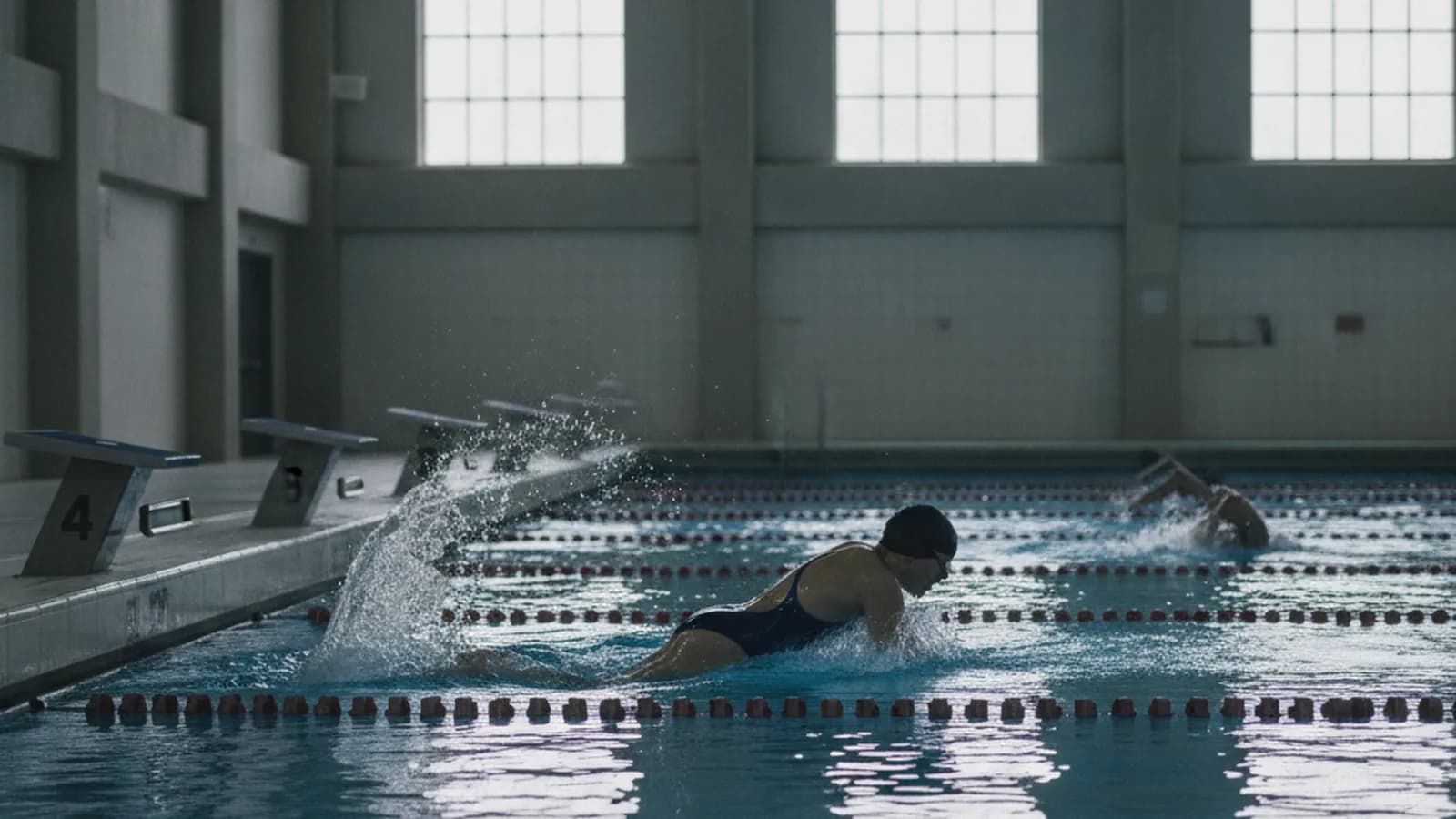
Image: AI-generated.
6 reasons for a swimming scholarship in the USA
Know your level before the first email
World Aquatics points turn your best times into one figure. A coach compares that figure with the roster. You see your level before you write.
30 roster places and full relays
A Division I team needs sprinters, distance swimmers, medley swimmers and relay depth. So swimming has many ways onto a team.
Two sessions a day, all close to campus
Your day has two training sessions, weights, classes, meals and physical therapy. All of it happens within a few hundred meters. For four years, the pool is right next door.
Race briefings at the pool, in English
Your coach explains split times and tactics in English before every race. After one season, you think in English in the water.
A team that trains at 6 a.m.
A swim team shares the same cold pool at 6 a.m. all year. The team spends more hours together than most teams on a field.
Becoming independent, because you run your own life
At 18, you move alone into student housing abroad. You handle laundry, a bank account and classes around two training sessions a day.
College swimming coaches compare your best times with their roster. Convert your times into World Aquatics points before you write to them.
Swimming teams and roster places by division
A team belongs to one university or college, one sport and one gender. A university or college with men's and women's soccer has two teams. We divide the roster places by the number of teams. The result is the size of a typical team in this sport.
Men
- D I29.2 Average squad size133
- D II22.8 Average squad size78
- NAIA17.4 Average squad size35
Teams, 2024-25
Women
- D I30.1 Average squad size195
- D II21.9 Average squad size97
- NAIA14.7 Average squad size36
Teams, 2024-25
| Division | Men, Teams | Women, Teams | Men, Average squad size | Women, Average squad size |
|---|---|---|---|---|
| NCAA Division I | 133 | 195 | 29.2 | 30.1 |
| NCAA Division II | 78 | 97 | 22.8 | 21.9 |
| NAIA | 35 | 36 | 17.4 | 14.7 |
What each column measures
- Division:
- Division names the association and the level of a university or college. The two NCAA levels D I and D II may give athletic scholarships. D III may not. The NAIA is a smaller second association, and it gives them too.
- Teams:
- A team belongs to one university or college, one sport and one gender. A university or college with men's and women's soccer has two teams.
- Average squad size:
- We divide the roster places by the number of teams. The result is the size of a typical team in this sport.
Roster limit, first contact and season for Swimming scholarships
Men
- Maximum squad size
- 30
- Scholarship limit before July 2025
- 9.9
- Teams
- 544
- First coach contact, school leavers of 2028
- 15 June 2026
Women
- Maximum squad size
- 30
- Scholarship limit before July 2025
- 14.0
- Teams
- 648
- First coach contact, school leavers of 2028
- 15 June 2026
- Competition season
- Winter season
- Ranking coaches use
- World Aquatics points
What each column measures
- Maximum squad size:
- The roster limit is the most athletes a team may have in this sport. Division I, the top NCAA level, has applied it since July 2025.
- Scholarship limit before July 2025:
- This was the scholarship limit per Division I team in this sport. It applied until July 2025. Since then, the limit counts athletes instead.
- Teams:
- A team belongs to one university or college, one sport and one gender. A university or college with men's and women's soccer has two teams.
- First coach contact, school leavers of 2028:
- A college coach may write to you or answer you from this date on. It applies if you finish school in 2028. You may write to coaches before that date.
- Competition season:
- These are the months in which this sport holds its competitions in the USA. The fall season starts in August. The spring season ends in May.
- Ranking coaches use:
- Coaches in this sport use this public ranking or measured result. They compare your level with their current team.
Swimming scholarships per Division I team
A Division I swimming team may fund every place on its roster. This applies if its university or college joined the House settlement. A men's team may have up to 30 swimmers. A women's team may have up to 30. The court settlement from 6 June 2025 ended the old scholarship limits. Roster limits took their place from 1 July 2025.
- Men's roster limit, Division I
- 30
- Women's roster limit, Division I
- 30
Divers count toward the limit
The 30 places cover sprint, distance, all four strokes, individual medley and diving. So coaches recruit for specific event groups.
Coaches fill gaps by event
A coach fills a gap in one event. The second-best backstroker available is a different case from the best breaststroker available.
Old caps outside the settlement
A Division I university or college outside the House settlement keeps the old caps. These caps allow 9.9 scholarships per men's team. A women's team may have 14.
Division II and NAIA cap money
Division II caps swimming aid at 8.1 scholarships per team. The NAIA is a separate association of smaller universities and colleges. It caps swimming aid at 8. Coaches split that money into partial scholarships.
Required level for a swimming scholarship
Swimming coaches compare your times with their current roster. They also use World Aquatics points, which put every event on one scale. College swimming races in 25-yard pools. Coaches convert times from 50 meter and 25 meter pools into yards.
- Yards per college pool length
- 25
- Division I teams
- 328
- Teams that give scholarships
- 574
Points put events on one scale
World Aquatics points put every event on one scale. A 100 meter freestyle compares with a 200 meter butterfly. A coach sees at a glance whether your events fit a gap.
Send times as you swam them
Send each best time in its original pool length, with meet and date. If you add a conversion to yards, name the method. Coaches do the math again themselves.
An undated time counts as old
In swimming, a tenth of a second can decide a race. So a coach treats an undated best time as an old one.
Qualifying times are another bar
NCAA championship qualifying times are the bar for the national meet. Most recruited swimmers arrive with slower times. So compare yourself with the roster.
Fewer programs in fewer regions
Swimming has fewer programs than the team sports. Most of these programs are in a few regions. So you need a long list of target universities and colleges.
Roster places in women's and men's college swimming
Women's swimming and diving has 328 teams with 8,514 roster places. Men's swimming has 246 teams with 6,274 places. Both counts cover Division I, Division II and the NAIA. Universities and colleges report these counts to the US Department of Education. Their report for 2024-25 is the EADA filing.
- Division I women's teams
- 195
- Division I men's teams
- 133
Places in Division I
In Division I, women have 5,865 places and men have 3,888 places.
Places in Division II
In Division II, women have 2,121 places and men have 1,778 places.
Places in the NAIA
The NAIA is a separate association of smaller universities and colleges. In the NAIA, women have 528 places and men have 608 places.
Average squad size in Division I
In 2024-25, the average Division I women's squad had 30 swimmers. The average men's squad had 29 swimmers. The roster limit of 30 applies from 1 July 2025.
Divers count with swimmers
These counts include divers. Some universities and colleges report diving as a separate team. The counts add diving to swimming.
Share of college swimmers from abroad
In Divisions I and II, 15.8 percent of the swimmers come from abroad. The NCAA register lists 11,025 swimmers. Of them, 1,745 come from outside the United States. These swimmers come from 103 countries. The register leaves out the NAIA and Division III.
- Division I men from abroad
- 18%
- Division I women from abroad
- 15%
- Of them from Europe
- 51%
Shares in Division I
In Division I, 18 percent of the men come from abroad. Among the women, the share is 15 percent.
Shares in Division II
In Division II, 18 percent of the men come from abroad. Among the women, the share is 13 percent.
Europe, Latin America and Canada
Of the swimmers from abroad, 51 percent come from Europe. Another 15 percent come from Latin America, and 13 percent from Canada.
Asia and the other regions
Of the swimmers from abroad, 8 percent come from Asia. Oceania, Africa and all other regions together add 13 percent.
Source: NCAA register of home countries, Divisions I and II. The Athletes Personal Dashboard for swimming lists every country with its number of swimmers.
Nursing and teaching degrees next to college swimming
You can study nursing or teaching and swim for a college team. But the season runs from September to the championships in February and March. Teams often train twice a day. Plan clinical placements or student teaching before year 2. Do this with your department and your coach.
- Degree credit before year 3
- 40%
- Degree credit before year 4
- 60%
- Degree credit before year 5
- 80%
Nursing and teaching fix your hours
Nursing sends you to clinical placements, which means supervised hospital shifts. Teacher education ends with student teaching. That means full school days in a classroom.
Montana Tech plans around meets
At Montana Tech, the nursing staff agree on schedules with coaches ahead of time. They place athletes in clinicals and labs on days the athletes are in town.
Olivet trains around school days
Education students who compete at Olivet Nazarene University train before or after school.
Book classes before everyone else
Priority registration lets athletes book classes around practice before other students do. Virginia Commonwealth University gives it to all athletes. The University of Maryland's engineering school gives it to every athlete it teaches.
An adviser tracks your eligibility
Eligibility is your right to compete. An athletes' academic adviser tracks your eligibility and progress toward your bachelor's degree. The University of Denver has such an adviser, for example. The adviser also helps you pick courses that fit practice and meets.
Settle the degree before year 2
Division I counts only credits toward your bachelor's degree. So a late switch into nursing or teaching can put your progress at risk.
Route to professional swimming and the Olympics
After college, swimmers can race for prize money at World Aquatics events. In 2025, an individual world title paid 20,000 dollars. Swimmers can also race for Olympic places. Each country gets at most 2 places in each individual event. The NCAA publishes no share of swimmers who turn professional.
- Swimmers at the LA28 Olympics
- 830
- Swimmers per country and event
- 2
- Prize for a world title
- US$20,000
LA28 qualifying starts in March 2027
Qualifying for LA28, the Los Angeles Olympics, starts on March 1, 2027. World Aquatics is the world swimming federation. It sets A and B entry times for at most 830 swimmers.
Your national committee enters you
Each country may enter at most 2 swimmers per individual event. World Aquatics confirms each place through the athlete's national Olympic committee.
World Championships prize money
The 2025 World Aquatics Championships took place in Singapore. Each individual event paid 20,000 dollars to the winner. A world record earned another 30,000 dollars.
A lump sum on retirement
World Aquatics pays a lump sum to athletes when they retire. Athletes qualify by competing at 80 percent of its events over four years. The money comes from a fund that started with 10 million dollars.
Prize money before and after enrolling
Division I lets you keep prize money you won before college. This applies if you first enroll from 1 August 2026 on. After you enroll, talk to the staff who apply the NCAA rules. Do this before you accept any prize money.
NIL deals while in college
Division I athletes may sign NIL deals. NIL means paid promotion that uses their name and image. The deal needs a real business purpose. On an F-1 student visa, ask the international office first.
Sources: World Aquatics on LA28 qualifying (December 12, 2025). Singapore 2025 championship rules. World Aquatics on its athlete fund (June 19, 2026). NCAA Division I Cabinet (April 15, 2026). NCAA rules on NIL.
Swimming dual meets and championships in February
Two teams sit on opposite sides of the pool at a college dual meet. Every race scores points for the team. The crowd sits so close to the water that you hear single voices.
The championships in February and March run over three days of heats and finals. Before them comes a taper, a planned cut in training. You build toward it from September.
Many swimmers say these meets came closest to an international final.

Swimming on US television and streaming
- TV networks show conference and national championships. Organizers post heat sheets and results for every meet.
- International federations accept times from college meets. So your own national federation can still follow your season in the USA.
Highest-aid universities and colleges per roster place
Universities and colleges report their athletic aid for men and for women. They do not report it for each sport. So the amount per roster place covers the whole sports department.
| University or college | Division | State | Fees waived per roster place |
|---|---|---|---|
| Southern Methodist University | D I | TX | US$56,388 |
| Northwestern University | D I | IL | US$53,919 |
| University of Denver | D I | CO | US$42,890 |
| Vanderbilt University | D I | TN | US$42,235 |
| Stanford University | D I | CA | US$42,012 |
| Rice University | D I | TX | US$41,166 |
| University of Southern California | D I | CA | US$40,006 |
| University of Miami | D I | FL | US$38,474 |
| Texas Christian University | D I | TX | US$37,174 |
| Tulane University of Louisiana | D I | LA | US$36,413 |
What each column measures
- Division:
- Division names the association and the level of a university or college. The two NCAA levels D I and D II may give athletic scholarships. D III may not. The NAIA is a smaller second association, and it gives them too.
- Fees waived per roster place:
- We divide the total fees waived by the roster places in the same report. A single scholarship can be much higher or much lower than this average.
Common questions about Swimming scholarships in the USA
Do I need NCAA qualifying times for a swimming scholarship?
How do I convert swimming times from meters to yards?
Do college coaches recruit divers on their own criteria?
What best times do I need for a swimming scholarship?
Which pool length counts for US college swimming coaches?
Does a swimming roster of 30 places mean 30 scholarships?
Can I combine college swimming with a demanding bachelor's degree?
What does a year of college swimming at a US university or college cost?
Rules for your athletic scholarship in the USA
Sources
Each figure comes from one of these sources. If no source reports a figure, we do not estimate one.
- U.S. Department of Education, Equity in Athletics Data Analysis (EADA) (22 August 2026)
- NCAA, DI Board of Directors formally adopts changes to roster limits (20 August 2026)
- NCAA, Question and Answer: Implementation of the House Settlement (updated 29 May 2026) (6 November 2026)
- NCAA, 2026-27 Division I Manual, Bylaw 17.2 (roster limits) (6 November 2026)
- College Sports Commission, Participating Schools (6 November 2026)
- NCAA Research, Country of Origin Spreadsheet for Student-Athletes, season 2021-22 (31 August 2026)
- NCAA, Division I Academics (progress toward degree) (11 November 2026)
- Virginia Commonwealth University, Student-Athlete Academic Services (11 November 2026)
- University of Maryland, A. James Clark School of Engineering, Engineering Student Athletes (11 November 2026)
- University of Denver, Student-Athlete Academic Services, Athletics Advising (11 November 2026)
- Montana Tech, Montana Tech students shatter myth that student-athletes can't major in nursing (2025) (11 November 2026)
- Olivet Nazarene University, Balanced performance: student teaching as a collegiate competitor (11 April 2025) (11 November 2026)
- World Aquatics, LA28 Olympic Games qualification system principles finalised for swimming and open water swimming (12 December 2025) (12 November 2026)
- World Aquatics, Swimming Qualification System LA28, Frequently Asked Questions (12 December 2025) (12 November 2026)
- World Aquatics, World Aquatics Championships Singapore 2025, Summons 2.0, Section 13 Prize Money (February 2025) (12 November 2026)
- World Aquatics, What World Aquatics offers its athletes: record-breaking prize money and a unique post-career compensation fund (19 June 2026) (12 November 2026)
- NCAA, DI Cabinet adopts changes to eligibility rules for prospects (15 April 2026) (12 November 2026)
- NCAA, Name, Image and Likeness (12 November 2026)
- NCAA, Probability of Competing Beyond High School (12 November 2026)
The editorial team of Athletic Scholarships USA writes and checks every text and figure. We are not an agency and do not place athletes at universities and colleges. When an agency would serve you better, we say so.