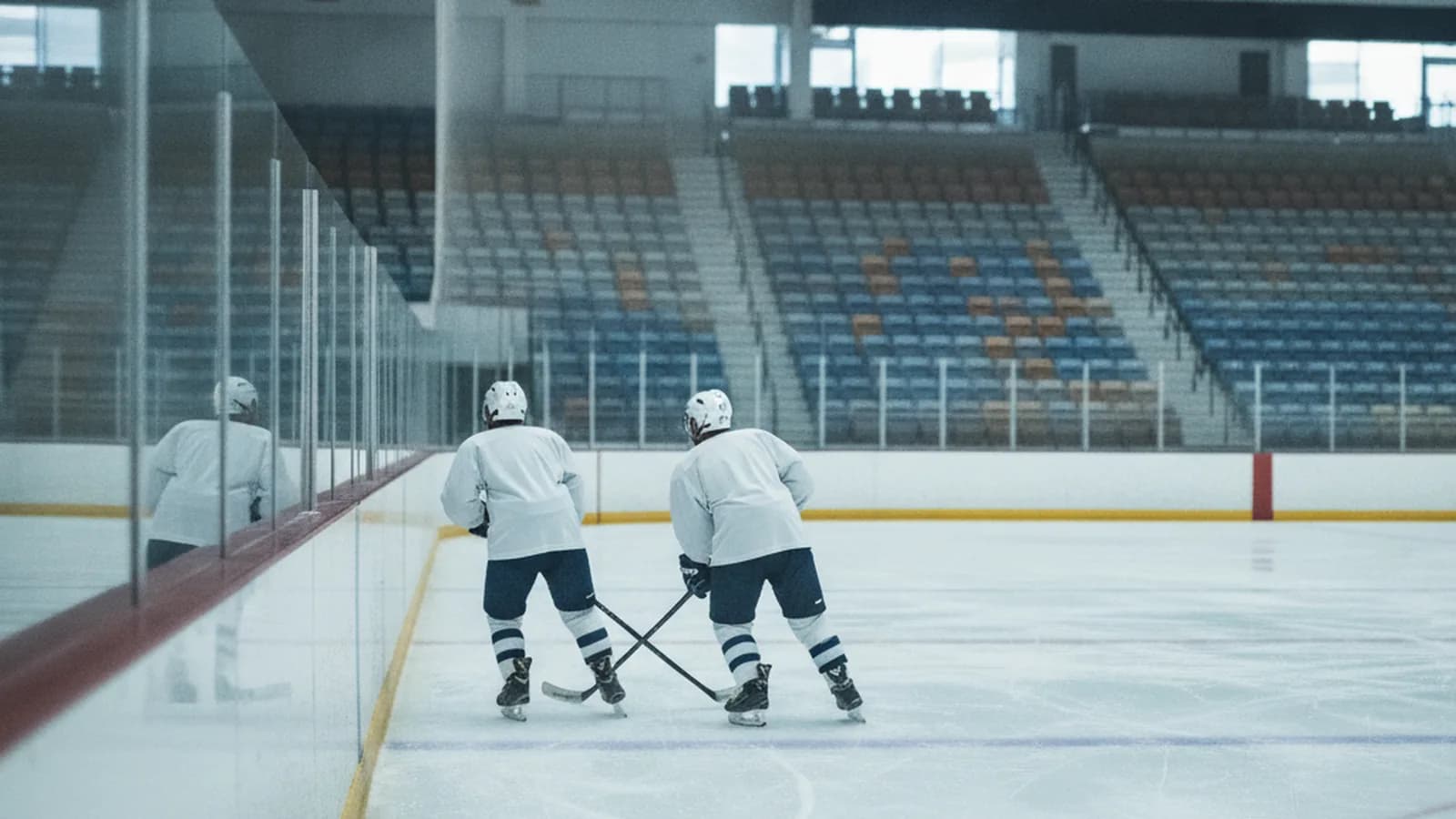
Ice hockey scholarships in the USA
An ice hockey scholarship pays for your bachelor's degree at US universities and colleges. College hockey is also a path into professional hockey. The NHL drafted 224 players in 2025. Of these players, 76 played NCAA hockey or had committed to it. A Division I team has up to 26 players. Men's coaches may contact you from January 1 of your 10th school year.
Image: AI-generated.
6 reasons for a ice hockey scholarship in the USA
Professional scouts watch college hockey
The NHL drafted 224 players in 2025. Of these players, 76 played NCAA hockey or had committed to it. Scouts go to college games as part of their routine.
Ice time on a roster of 26
A roster of 26 fits four lines, three defense pairs and the goaltenders. Few players sit as extras.
A degree as insurance for a short career
Hockey careers are short, and an injury can end one without warning. Four years of college hockey come with a finished bachelor's degree.
Fluent English from the bench
Systems, bench calls and interviews after games all happen in English, in real time. After one season, you think in English on the ice.
Friends from a small locker room
On a roster of 26, everyone knows everyone. Long bus rides and flights together often turn teammates into friends for life.
Independence, because you organize everything yourself
You plan your own gear, travel and classes at 19 or 20. You do this in North America, next to a long season.
An injury can end a hockey career at any age. Four years of college hockey give you a bachelor's degree to fall back on.
Ice hockey teams and roster places by division
A team belongs to one university or college, one sport and one gender. A university or college with men's and women's soccer has two teams. We divide the roster places by the number of teams. The result is the size of a typical team in this sport.
Men
- D I28.7 Average squad size43
- D II29.2 Average squad size19
- NAIA36.4 Average squad size8
Teams, 2024-25
Women
- D I25.4 Average squad size30
- D II25.5 Average squad size10
- NAIA19.2 Average squad size4
Teams, 2024-25
| Division | Men, Teams | Women, Teams | Men, Average squad size | Women, Average squad size |
|---|---|---|---|---|
| NCAA Division I | 43 | 30 | 28.7 | 25.4 |
| NCAA Division II | 19 | 10 | 29.2 | 25.5 |
| NAIA | 8 | 4 | 36.4 | 19.2 |
What each column measures
- Division:
- Division names the association and the level of a university or college. The two NCAA levels D I and D II may give athletic scholarships. D III may not. The NAIA is a smaller second association, and it gives them too.
- Teams:
- A team belongs to one university or college, one sport and one gender. A university or college with men's and women's soccer has two teams.
- Average squad size:
- We divide the roster places by the number of teams. The result is the size of a typical team in this sport.
Roster limit, first contact and season for Ice hockey scholarships
Men
- Maximum squad size
- 26
- Scholarship limit before July 2025
- 18.0
- Teams
- 168
- First coach contact, school leavers of 2028
- 1 January 2026
Women
- Maximum squad size
- 26
- Scholarship limit before July 2025
- 18.0
- Teams
- 128
- First coach contact, school leavers of 2028
- 8 September 2026
- Competition season
- Winter season
- Ranking coaches use
- no figure reported
What each column measures
- Maximum squad size:
- The roster limit is the most athletes a team may have in this sport. Division I, the top NCAA level, has applied it since July 2025.
- Scholarship limit before July 2025:
- This was the scholarship limit per Division I team in this sport. It applied until July 2025. Since then, the limit counts athletes instead.
- Teams:
- A team belongs to one university or college, one sport and one gender. A university or college with men's and women's soccer has two teams.
- First coach contact, school leavers of 2028:
- A college coach may write to you or answer you from this date on. It applies if you finish school in 2028. You may write to coaches before that date.
- Competition season:
- These are the months in which this sport holds its competitions in the USA. The fall season starts in August. The spring season ends in May.
- Ranking coaches use:
- Coaches in this sport use this public ranking or measured result. They compare your level with their current team.
Ice hockey scholarships per Division I team
A Division I ice hockey team may fund every place on its roster. The limit is 26 players for men and 26 for women. This applies if its university or college joined the House settlement. That court settlement from 6 June 2025 ended the old limit of 18 scholarships. A roster limit took its place from 1 July 2025.
- Roster limit, Division I
- 26
- Former scholarship limit
- 18
- Average Division I men's squad
- 29
18 scholarships, split into partial awards
A Division I team could spend the value of 18 full scholarships. That limit applied until 1 July 2025. So hockey funded a larger share of its roster than most sports.
The university or college decides on full funding
Universities and colleges in the House settlement leave full funding to the athletic department. It decides whether the hockey team funds all 26 places.
Old limit outside the settlement
Some Division I universities and colleges did not join the House settlement. They still keep the old limit of 18 scholarships per team.
Division II and NAIA cap money
Division II and the NAIA limit the scholarship money per team. The NAIA is a separate association of smaller universities and colleges. In both, teams spread partial scholarships across the players.
Required level for an ice hockey scholarship
Ice hockey coaches judge your league and your role first. Your statistics come after that. A fourth-line forward in a strong adult league is easy to judge. The top scorer of a weak junior league is harder to judge. Eligibility is your right to compete in college sport. Your 5 years of eligibility start at age 19.
- NCAA Division I men's teams
- 59
- NCAA Division I women's teams
- 35
League and role before statistics
A coach looks at your league, your ice time and your role. The coach also checks how you played against players your age in that league.
Recruits arrive at 19 or 20
College teams often recruit hockey players who arrive at 19 or 20. By then, these players have several seasons of junior hockey behind them.
The age clock opens at 19
Division I has applied a new age rule since 24 June 2026. Your eligibility clock starts after your 19th birthday. Your 5 years begin with the next academic year. This is true whether you enroll or not.
Coaches recruit by position and hand
Coaches fill left-handed defensemen and goaltenders on separate cycles. A roster of 26 shows a coach which positions each new class needs.
Goaltenders start a year earlier
Teams carry 2 or 3 goaltenders and fill the spot years ahead. So a goaltender contacts coaches a year before a skater of the same age.
A short list of universities and colleges
Most college hockey teams play in the Northeast and the upper Midwest. You can read every Division I roster in one afternoon.
Roster places in college ice hockey
Division I, Division II and the NAIA have 70 men's ice hockey teams. These teams have 2,079 roster places. Women's ice hockey has 44 teams with 1,093 places. The universities and colleges report these numbers to the US Department of Education. They do this in the EADA filing for 2024-25.
- Division I men's teams
- 43
- Division I women's teams
- 30
Places in Division I
Division I has 1,233 of the men's roster places. It also has 761 of the women's places.
Places in Division II
Division II has 555 men's and 255 women's roster places.
Places in the NAIA
The NAIA is a separate association of smaller universities and colleges. Its members report 8 men's teams with 291 roster places. They also report 4 women's teams with 77 places.
NCAA count with more teams
The NCAA lists 59 men's and 35 women's teams in Division I. The federal report uses the main division of each university or college. So it counts fewer teams.
Average squad in Division I
In 2024-25, the average Division I men's team had 29 players. The average women's team had 25.
Share of college ice hockey players from abroad
In Divisions I and II, 35.2 percent of hockey players come from abroad. The NCAA register counts 920 of 2,610 players from outside the US. Of these players, 760 are from Canada. The register leaves out the NAIA and Division III.
- Division I men from abroad
- 37%
- Division I women from abroad
- 43%
- Of them from Europe
- 17%
Women recruit more abroad
In Division I, 43 percent of the women come from abroad. Among the men, it is 37 percent.
Few foreign players in Division II
In Division II, 3 percent of the men come from abroad. Among the women, it is 12 percent.
Canada supplies 83 percent
Of the ice hockey players from abroad, 83 percent come from Canada. That is 760 players.
Sweden leads in Europe
Europe supplies 17 percent of the players from abroad. Sweden sends 51 players and Finland 28. The Czech Republic sends 18. In total, players come from 25 countries.
Only tennis and skiing recruit more
The NCAA register covers 21 college sports. Only tennis and skiing have a higher share from abroad than ice hockey.
Source: NCAA register of home countries, Divisions I and II, season 2021-22. The Athletes Personal Dashboard for ice hockey lists every country with its player count.
Nursing and teaching degrees next to ice hockey
You can study nursing or teaching and play college ice hockey. Both degrees include placements, which are blocks of practical training. These placements clash with the season, which runs from October to early April. Ask the department early about placements outside the season. Pick your bachelor's degree before year 2.
- Degree credit before year 3
- 40%
- Degree credit before year 4
- 60%
- Degree credit before year 5
- 80%
Nursing and teaching fix your hours
Nursing sends you to clinical placements, which means supervised hospital shifts. Teacher education ends with student teaching. That means full school days in a classroom.
The season spans both semesters
Games start in October, and the national tournament ends in early April. So both semesters have games. Ask early which weeks the department can move.
Montana Tech plans around games
The Montana Tech nursing staff agree on schedules with coaches ahead of time. They place athletes in clinicals and labs on days the team is home.
Marquette books clinicals on quiet days
At Marquette University, nursing students who compete work with clinical coordinators. Together they place clinical shifts on days with less team practice.
Book classes before everyone else
Priority registration lets athletes book classes around practice before other students. Virginia Commonwealth University gives it to all athletes. The University of Maryland's engineering school gives it to every athlete it teaches.
An adviser tracks your eligibility
Some universities and colleges give athletes an academic adviser, like the University of Denver. The adviser checks your progress and your eligibility, your right to compete. Division I counts only credits toward your bachelor's degree.
Route to professional ice hockey after college sport
The NHL is the top professional league in North America. Men get there through the NHL draft. The draft takes place every June and has 7 rounds. Players who turn 18 by September 15 can enter it. The NHL drafted 224 players in 2025. Of these players, 76 played NCAA hockey or had committed to it.
- NHL Draft picks, 2025
- 224
- Of them NCAA players
- 76
- PWHL Draft picks, 2026
- 72
Your NHL club waits for you
The NHL agreement gives your drafting club the sole right to sign you. This right lasts while you are still a university or college student.
An agent only for contract talks
The NHL may draft a men's ice hockey player before college sport. Then he may use an agent for contract talks. Without a contract, he must end that agreement before he enrolls full time.
Major Junior keeps eligibility since 2025
Major Junior means the Canadian leagues OHL, WHL and QMJHL. Since August 1, 2025, men from these leagues keep their NCAA eligibility. This holds if no team paid them more than actual and necessary expenses.
The team decides, not the league
The NCAA judges each team on its own. A team counts as professional if it calls itself professional. So does a team that pays any player more than actual and necessary expenses.
Women enter the PWHL Draft
The PWHL is the Professional Women's Hockey League. It held its draft on June 17, 2026. It picked 72 players in 6 rounds. Of these players, 59 came from NCAA teams. Players sign up for the draft themselves.
Europe after college sport
European leagues also sign players after college sport. Without a contract, players often take a job in their field. Others study for a master's degree or start coaching.
Sources: NHL and NHLPA collective bargaining agreement, Article 8 (February 15, 2013). NCAA table on professional chances. NCAA ice hockey certification flyer (November 2025). Division I Council (November 7, 2024). PWHL (June 17, 2026).
Weekend series in small, full college rinks
College hockey rinks are small, full and loud. Crowds differ a lot from team to team. Many rinks have a student section with chants for the visiting goaltender.
In most weeks, the same two teams meet on Friday and Saturday night.
Some rivalries go back a century, with a game every year. Those games feel more like a European football derby than junior hockey.


Ice hockey on US television and streaming
- Conference streaming services show the games of the regular season. A TV network shows the national tournament in March. Professional hockey scouts watch the national tournament every year.
- College hockey has only a small number of teams. So each player gets far more attention than the TV audience numbers suggest.
Highest-aid universities and colleges per roster place
Universities and colleges report their athletic aid for men and for women. They do not report it for each sport. So the amount per roster place covers the whole sports department.
| University or college | Division | State | Fees waived per roster place |
|---|---|---|---|
| University of Denver | D I | CO | US$42,890 |
| University of Notre Dame | D I | IN | US$34,391 |
| Syracuse University | D I | NY | US$33,068 |
| Boston College | D I | MA | US$29,391 |
| University of Michigan-Ann Arbor | D I | MI | US$28,650 |
| Boston University | D I | MA | US$27,954 |
| Arizona State University Campus Immersion | D I | AZ | US$27,490 |
| University of Minnesota-Twin Cities | D I | MN | US$27,174 |
| Ohio State University-Main Campus | D I | OH | US$27,151 |
| Quinnipiac University | D I | CT | US$27,084 |
What each column measures
- Division:
- Division names the association and the level of a university or college. The two NCAA levels D I and D II may give athletic scholarships. D III may not. The NAIA is a smaller second association, and it gives them too.
- Fees waived per roster place:
- We divide the total fees waived by the roster places in the same report. A single scholarship can be much higher or much lower than this average.
Common questions about Ice hockey scholarships in the USA
Does playing junior hockey cost me my NCAA eligibility?
When can a college ice hockey coach first contact me?
Am I too old for an ice hockey scholarship at 20?
Does a college hockey roster of 26 places carry 26 scholarships?
How many US universities and colleges run an ice hockey team?
What does a college ice hockey place cost me?
Do college coaches recruit ice hockey goaltenders in a different way?
Can I play professional ice hockey in Europe after college sport?
Rules for your athletic scholarship in the USA
Sources
Each figure comes from one of these sources. If no source reports a figure, we do not estimate one.
- U.S. Department of Education, Equity in Athletics Data Analysis (EADA) (22 August 2026)
- NCAA, DI Board of Directors formally adopts changes to roster limits (20 August 2026)
- NCAA, Question and Answer: Implementation of the House Settlement (updated 29 May 2026) (6 November 2026)
- NCAA, 2026-27 Division I Manual, Bylaw 17.2 (roster limits) (6 November 2026)
- College Sports Commission, Participating Schools (6 November 2026)
- NCAA Research, Country of Origin Spreadsheet for Student-Athletes, season 2021-22 (31 August 2026)
- NCAA, Division I Academics (progress toward degree) (12 November 2026)
- Virginia Commonwealth University, Student-Athlete Academic Services (12 November 2026)
- University of Maryland, A. James Clark School of Engineering, Engineering Student Athletes (12 November 2026)
- University of Denver, Student-Athlete Academic Services, Athletics Advising (12 November 2026)
- Montana Tech, Montana Tech students shatter myth that student-athletes can't major in nursing (2025) (12 November 2026)
- Marquette University, How do student-athletes balance nursing and sports? (26 March 2025) (12 November 2026)
- NHL and NHLPA, Collective Bargaining Agreement (15 February 2013), Article 8, Entry Draft (12 November 2026)
- NCAA Division I Athletics Certification, Men's and Women's Ice Hockey (12 November 2026)
- NCAA Division I Men's Ice Hockey, Preenrollment Involvement With Professional Teams FAQ (12 November 2026)
- NCAA, DI Council approves rules change for preenrollment activities in men's ice hockey, skiing (12 November 2026)
- NCAA, Probability of Competing Beyond High School (12 November 2026)
- PWHL, PWHL completes 2026 Draft presented by Upper Deck (17 June 2026) (12 November 2026)
- PWHL, 2026 PWHL Draft eligibility list features record number of player declarations (12 May 2026) (12 November 2026)
The editorial team of Athletic Scholarships USA writes and checks every text and figure. We are not an agency and do not place athletes at universities and colleges. When an agency would serve you better, we say so.