Baseball scholarships in the USA
A baseball scholarship pays for your bachelor's degree at US universities and colleges. You play for the team while you study. In the US, 1,670 universities and colleges have a baseball team. MLB teams picked 615 players in the 2025 draft. Of these players, 452 came from NCAA universities and colleges. A Division I team may carry 34 players, and most scholarships stay partial.
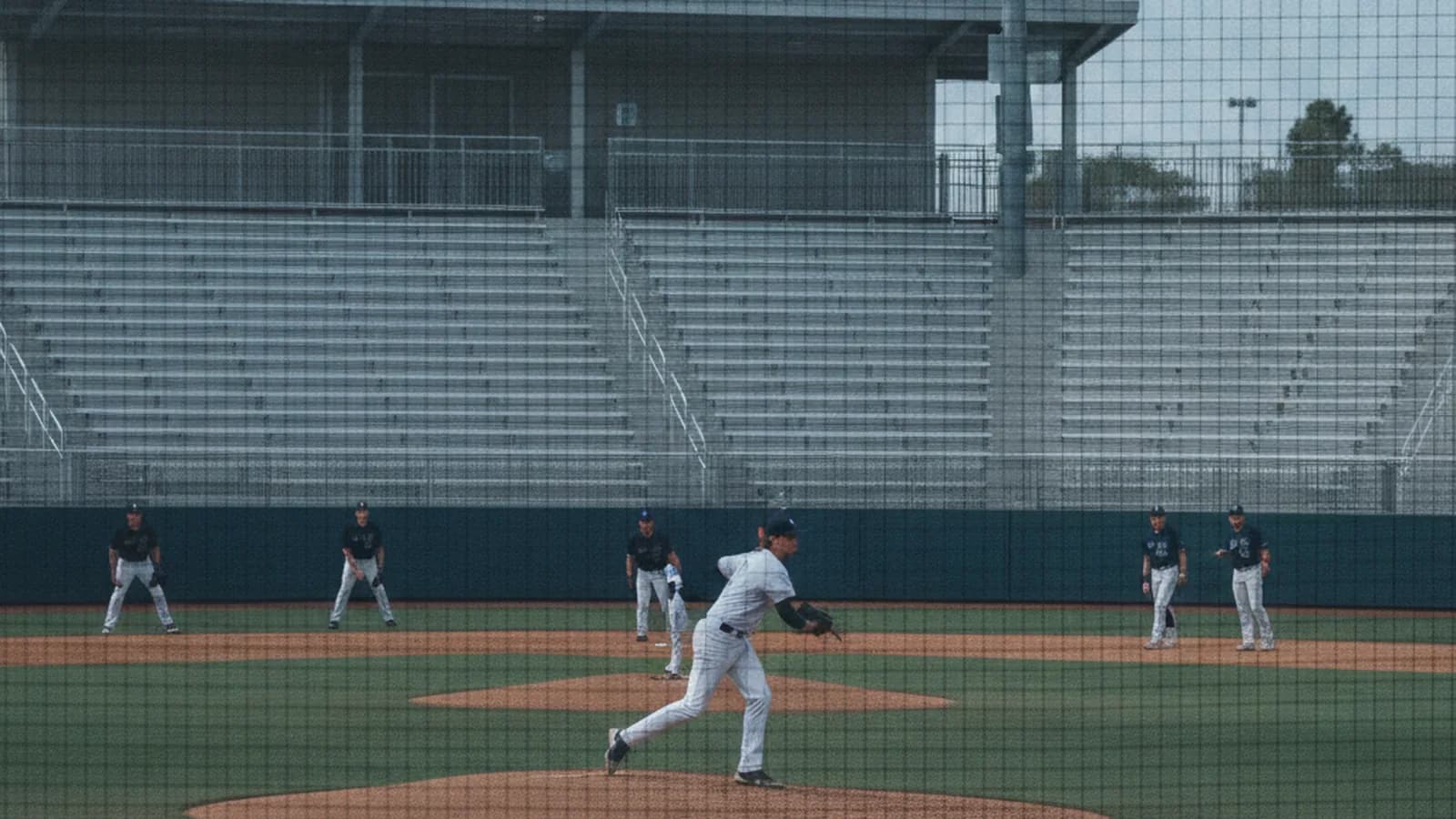
Image: AI-generated.
6 reasons for a baseball scholarship in the USA
1,670 college baseball teams in all divisions
Division I, Division II and the NAIA alone have 739 of these teams. So your list of realistic targets in baseball can be long.
Most MLB draft picks come from college
MLB teams made 615 picks in the 2025 draft. Of these picks, 452 came from NCAA universities and colleges. A player nobody drafts still leaves with a bachelor's degree.
34 roster places for many positions
A Division I team needs new pitchers, catchers and position players every year. So baseball offers many ways onto a roster.
Baseball vocabulary learned in English
Baseball has its own words for stats, plays and the talk before a game. You learn them in English in the dugout.
A long spring season spent together
A baseball team spends almost every day together from February to June. The players meet in practice, on the bus and on the field.
Training, travel and coursework at once
From February to June, you manage training, travel and coursework at the same time. That teaches you to carry a heavy load.
MLB teams picked 615 players in the 2025 draft. Of these players, 452 came from NCAA universities and colleges.
Baseball teams and roster places by division
A team belongs to one university or college, one sport and one gender. A university or college with men's and women's soccer has two teams. We divide the roster places by the number of teams. The result is the size of a typical team in this sport.
Men
- D I40.5 Average squad size300
- D II47.3 Average squad size254
- NAIA52.2 Average squad size185
Teams, 2024-25
| Division | Men, Teams | Men, Average squad size |
|---|---|---|
| NCAA Division I | 300 | 40.5 |
| NCAA Division II | 254 | 47.3 |
| NAIA | 185 | 52.2 |
What each column measures
- Division:
- Division names the association and the level of a university or college. The two NCAA levels D I and D II may give athletic scholarships. D III may not. The NAIA is a smaller second association, and it gives them too.
- Teams:
- A team belongs to one university or college, one sport and one gender. A university or college with men's and women's soccer has two teams.
- Average squad size:
- We divide the roster places by the number of teams. The result is the size of a typical team in this sport.
Roster limit, first contact and season for Baseball scholarships
Men
- Maximum squad size
- 34
- Scholarship limit before July 2025
- 11.7
- Teams
- 1,670
- First coach contact, school leavers of 2028
- 1 August 2026
- Competition season
- Spring season
- Ranking coaches use
- no figure reported
What each column measures
- Maximum squad size:
- The roster limit is the most athletes a team may have in this sport. Division I, the top NCAA level, has applied it since July 2025.
- Scholarship limit before July 2025:
- This was the scholarship limit per Division I team in this sport. It applied until July 2025. Since then, the limit counts athletes instead.
- Teams:
- A team belongs to one university or college, one sport and one gender. A university or college with men's and women's soccer has two teams.
- First coach contact, school leavers of 2028:
- A college coach may write to you or answer you from this date on. It applies if you finish school in 2028. You may write to coaches before that date.
- Competition season:
- These are the months in which this sport holds its competitions in the USA. The fall season starts in August. The spring season ends in May.
- Ranking coaches use:
- Coaches in this sport use this public ranking or measured result. They compare your level with their current team.
Baseball scholarships per Division I team
In Division I, a baseball team may fund all 34 roster places. This applies if its university or college joined the House settlement. Most programs still split the money into partial scholarships. Before July 2025, the limit was 11.7 scholarships for the whole team. So a full scholarship was rare.
- Roster limit, Division I
- 34
- Former scholarship limit
- 11.7
- Average Division I squad
- 41
House settlement replaced the limits
The House settlement is a court settlement from 6 June 2025. It replaced scholarship limits with roster limits from 1 July 2025. This applies at the Division I universities and colleges that joined it.
Each university or college decides its funding
A university or college in the settlement may fund all 34 places. Each one decides for itself whether it does.
The limit cut places
In 2024-25, the average Division I team had 41 players. The new limit of 34 cut places at many programs.
Old caps outside the settlement
Some Division I universities and colleges did not join the House settlement. They still split 11.7 scholarships across the team.
Division II and NAIA cap money
Division II and the NAIA cap the scholarship money per team. The NAIA is a separate association of smaller universities and colleges. A coach in either one can split the money into partial scholarships.
Required level for a baseball scholarship
For a baseball scholarship, you need measured numbers a coach can compare. Pitchers send their fastball velocity, the shape of their other pitches and their command. Position players send their 60-yard time, exit velocity, arm strength and defense. Add the date and the measuring device for each number.
- Division I teams
- 300
- Division II teams
- 254
- NAIA teams
- 185
Exit velocity explained
Exit velocity is the speed of the ball off your bat. Show any radar or bat-sensor reading on screen at the moment you measured it.
Name a league coaches can check
Give your country, league and level in a form an American can look up. Also state your innings or plate appearances this season.
Real innings beat a famous academy
A player with real innings in a strong home league is easy to place. A bench player at a famous academy is harder to place.
Position matters as much as level
Coaches recruit catchers and left-handed pitchers on a different schedule than outfielders. They fill set positions with each new class of players.
No world ranking for amateurs
Amateur baseball has no world ranking that college coaches read. So the measured numbers in your first email carry the weight.
Roster places in college baseball
Division I, Division II and the NAIA have 739 men's baseball teams. Those teams have 33,794 roster places. Universities and colleges report these counts to the US Department of Education. Their EADA filing for 2024-25 holds the counts. The NCAA and the NAIA run baseball for men only.
- Division I places
- 12,135
- Division II places
- 12,009
- NAIA places
- 9,650
Teams per division
Division I has 300 baseball teams, and Division II has 254. The NAIA is a separate association of smaller universities and colleges. It has 185 baseball teams.
Average squad size per division
In Division I, the average team had 41 players. In Division II, it had 47. In the NAIA, it had 52. These averages are for 2024-25.
Roster limit since 2025
Since 1 July 2025, a Division I team may carry 34 players. This applies at universities and colleges in the House settlement.
Depth below Division I
Division I has 300 teams. Division II has 254 teams, and the NAIA has 185.
What the EADA filing counts
Every university or college with federal student aid must report its teams and athletes. It sends this report to the US Department of Education each year. That yearly report is the EADA filing.
Share of college baseball players from abroad
In Divisions I and II, 1.9 percent of baseball players come from abroad. The NCAA keeps a register of home countries. Of its 18,191 players, 353 have a home country outside the US. These players come from 26 countries. The register leaves out the NAIA and Division III.
- Division I players from abroad
- 2%
- Division II players from abroad
- 2%
- Of them from Canada
- 62%
Canada supplies the largest group
Canada sends 62 percent of the baseball players from abroad. Latin America sends 22 percent of them.
Asia, Europe and the rest
Asia sends 4 percent and Europe 3 percent. Oceania, Africa and all other regions together send 8 percent.
The same share in both divisions
In Division I, 2 percent of the baseball players come from abroad. In Division II, the share is 2 percent.
Source: NCAA register of home countries, Divisions I and II. The Athletes Personal Dashboard for baseball lists every country with its player count.
Nursing and teaching degrees next to college baseball
Nursing and teaching degrees fit next to college baseball. But both bachelor's degrees include placements, and these clash with the season. The season lasts 5 months, from February to June. Teams also play during the week. Ask your department early to move clinical blocks or student teaching to the fall.
- Degree credit before year 3
- 40%
- Degree credit before year 4
- 60%
- Degree credit before year 5
- 80%
Nursing and teaching fix your hours
Nursing students do clinical placements, which means supervised hospital shifts. Teacher education ends with student teaching, which means full school days in a classroom.
Fall brings only games within the team
College baseball coaches test their players in games within the team each fall. So a placement in the fall semester makes you miss no official game.
Montana Tech plans around games
The Montana Tech nursing staff agree on schedules with the coaches in advance. They put athletes in clinical placements and labs on days the team is home.
Marquette treats both as fixed
Marquette University says nursing timetables and team practice are both fixed. Its athletes in nursing manage both with help from faculty and staff.
Book classes before everyone else
Priority registration lets athletes book classes before other students. That way, they can fit classes around practice. Virginia Commonwealth University gives it to all athletes. The University of Maryland's engineering school gives it to every athlete it teaches.
Settle the degree before year 2
Division I counts only credits that move you toward your bachelor's degree. So a late switch into nursing or teaching can put your progress at risk.
Route to professional baseball after college
College players reach professional baseball through the MLB Draft. In July 2026, the draft had 20 rounds. A player at a four-year university or college becomes eligible after his third year. He also becomes eligible once he turns 21. The NCAA counted the 2025 draft. MLB clubs picked 4.9 percent of the draft-eligible NCAA players.
- Rounds in the MLB Draft
- 20
- Draft-eligible NCAA players picked
- 4.9%
- NCAA players among 2025 picks
- 452
Junior college after one year
A junior college is a two-year college. A player there becomes eligible after one completed year. A high school graduate who never enrolled is eligible right away.
College enrollment counts as residence
The draft covers residents of the USA and Canada. MLB also counts some players as residents. These players enrolled at a US university or college in the year before signing.
Signing ends college eligibility
Signing a professional contract ends your college eligibility for good. Four years of development and a degree beat most modest offers. You also get a second chance at the draft.
Bonus pools for ten rounds
Each pick in the first 10 rounds has a slot value. Together, the values make up a club's bonus pool. A club may spend that pool without a penalty.
Back to college means waiting
Some drafted players return to their university or college for the next semester. Such a player can no longer sign with the club. He waits for the next draft he is eligible for.
International amateurs sign from 17
Some players live outside the USA and Canada and never enrolled there. They sign as international amateur free agents. They must turn 17 by September 1 of the signing year.
Sources: MLB glossary on the Rule 4 Draft and international amateur free agency. MLB overview of the 2026 Draft. Major League Rules 2024, Rule 3. NCAA, Probability of Competing Beyond High School.
Three games a weekend, some fifty a season
College baseball teams play weekend series. A series is three games against the same opponent, from Friday to Sunday. The games take place in a campus stadium.
Southern programs draw several thousand fans to a Friday night game in March.
The season comes close to a professional schedule. You play some fifty games in four months, some of them during the week.
You travel by bus and plane. You spend more waking hours in the locker room than in your dorm.

Baseball on US television and streaming
- Conference streaming services show the regular season. In June, national TV shows the College World Series, and professional scouts watch it.
- Professional teams follow college baseball as a routine. So college baseball helps players grow, and it does not hold their careers back.
Highest-aid universities and colleges per roster place
Universities and colleges report their athletic aid for men and for women. They do not report it for each sport. So the amount per roster place covers the whole sports department.
| University or college | Division | State | Fees waived per roster place |
|---|---|---|---|
| Northwestern University | D I | IL | US$53,919 |
| Vanderbilt University | D I | TN | US$42,235 |
| Stanford University | D I | CA | US$42,012 |
| Rice University | D I | TX | US$41,166 |
| Loyola Marymount University | D I | CA | US$40,056 |
| University of Southern California | D I | CA | US$40,006 |
| Wake Forest University | D I | NC | US$38,933 |
| University of Miami | D I | FL | US$38,474 |
| Texas Christian University | D I | TX | US$37,174 |
| Tulane University of Louisiana | D I | LA | US$36,413 |
What each column measures
- Division:
- Division names the association and the level of a university or college. The two NCAA levels D I and D II may give athletic scholarships. D III may not. The NAIA is a smaller second association, and it gives them too.
- Fees waived per roster place:
- We divide the total fees waived by the roster places in the same report. A single scholarship can be much higher or much lower than this average.
Common questions about Baseball scholarships in the USA
Should I sign a professional baseball contract or take a baseball scholarship?
Does a Division I baseball roster of 34 carry 34 full scholarships?
When can a baseball coach first contact me?
Am I still an amateur after a baseball academy?
What does a college baseball place cost me?
Do I need a ranking for a baseball scholarship?
Can I play for my national baseball team on a scholarship?
When can a college baseball player enter the MLB Draft?
Rules for your athletic scholarship in the USA
Sources
Each figure comes from one of these sources. If no source reports a figure, we do not estimate one.
- U.S. Department of Education, Equity in Athletics Data Analysis (EADA) (22 August 2026)
- NCAA, DI Board of Directors formally adopts changes to roster limits (20 August 2026)
- NCAA, Question and Answer: Implementation of the House Settlement (updated 29 May 2026) (6 November 2026)
- NCAA, 2026-27 Division I Manual, Bylaw 17.2 (roster limits) (6 November 2026)
- College Sports Commission, Participating Schools (6 November 2026)
- NCAA Research, Country of Origin Spreadsheet for Student-Athletes, season 2021-22 (31 August 2026)
- NCAA, Division I Academics (progress toward degree) (11 November 2026)
- Virginia Commonwealth University, Student-Athlete Academic Services (11 November 2026)
- University of Maryland, A. James Clark School of Engineering, Engineering Student Athletes (11 November 2026)
- University of Denver, Student-Athlete Academic Services, Athletics Advising (11 November 2026)
- Montana Tech, Montana Tech students shatter myth that student-athletes can't major in nursing (2025) (11 November 2026)
- Marquette University, How do student-athletes balance nursing and sports? (26 March 2025) (11 November 2026)
- Olivet Nazarene University, Balanced performance: student teaching as a collegiate competitor (11 April 2025) (11 November 2026)
- MLB, Glossary, Rule 4 Draft (12 November 2026)
- MLB, Glossary, International Amateur Free Agency & Bonus Pool Money (12 November 2026)
- MLB, Here's what you need to know about the 2026 MLB Draft (12 November 2026)
- Office of the Commissioner of Baseball, Major League Rules 2024, Rule 3 (copy published by the MLBPA) (12 November 2026)
- NCAA, Probability of Competing Beyond High School (12 November 2026)
The editorial team of Athletic Scholarships USA writes and checks every text and figure. We are not an agency and do not place athletes at universities and colleges. When an agency would serve you better, we say so.