Fencing scholarships in the USA
A fencing scholarship pays for your bachelor's degree at US universities and colleges. The FIE is the world fencing federation. In college fencing, the NCAA turns your FIE world rank into points. The top 8 senior fencers get 140 points each. In NCAA Divisions I and II, 17.9 percent of fencers come from abroad.
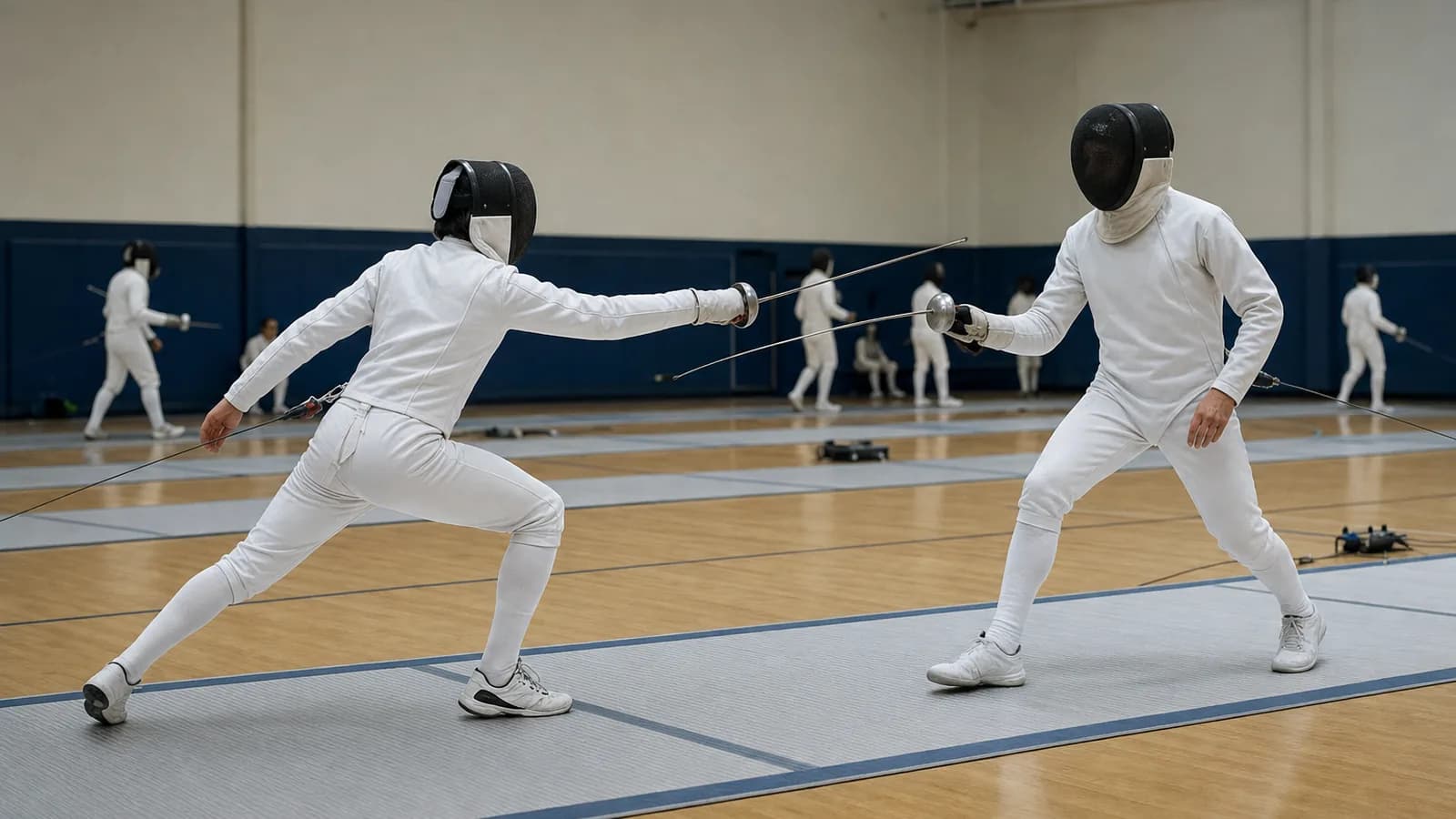
Image: AI-generated.
6 reasons for a Fencing scholarship in the USA
Your FIE place has a fixed value
The NCAA's selection manual gives each FIE senior rank a fixed value. The top 8 get 140 points. Ranks 65 to 96 form the lowest band. That band gets 110 points.
17.9 percent of fencers come from abroad
In Divisions I and II, 88 of 492 fencers come from abroad. Canada, Hungary, Italy, Ukraine and France send the largest groups.
One championship for all three divisions
Divisions I, II and III fence one NCAA championship together. Since 2026, it gives separate team titles for men and for women.
Up to 24 funded places per team
A Division I team in the House settlement may fund 24 fencers. The old limit was 4.5 scholarships for men and 5 for women.
A field small enough to contact in full
Division I has 23 men's and 28 women's teams. So a careful application can reach every coach.
Separate rankings for each weapon
The FIE ranks epee, foil and saber apart, by sex and by age. Senior men's epee alone lists 1,228 fencers from 113 nations.
The NCAA turns your FIE world rank into points. Senior ranks 65 to 96 count as one band. That band is worth 110 points. Below rank 96, you get no points.
Fencing teams and roster places by division
A team belongs to one university or college, one sport and one gender. A university or college with men's and women's soccer has two teams. We divide the roster places by the number of teams. The result is the size of a typical team in this sport.
Men
- D I18.7 Average squad size22
- D II16.0 Average squad size1
- NAIA3.0 Average squad size1
Teams, 2024-25
Women
- D I17.5 Average squad size27
- D II9.0 Average squad size1
- NAIA3.0 Average squad size1
Teams, 2024-25
| Division | Men, Teams | Women, Teams | Men, Average squad size | Women, Average squad size |
|---|---|---|---|---|
| NCAA Division I | 22 | 27 | 18.7 | 17.5 |
| NCAA Division II | 1 | 1 | 16.0 | 9.0 |
| NAIA | 1 | 1 | 3.0 | 3.0 |
What each column measures
- Division:
- Division names the association and the level of a university or college. The two NCAA levels D I and D II may give athletic scholarships. D III may not. The NAIA is a smaller second association, and it gives them too.
- Teams:
- A team belongs to one university or college, one sport and one gender. A university or college with men's and women's soccer has two teams.
- Average squad size:
- We divide the roster places by the number of teams. The result is the size of a typical team in this sport.
Roster limit, first contact and season for Fencing scholarships
Men
- Maximum squad size
- 24
- Scholarship limit before July 2025
- 4.5
- Teams
- 36
- First coach contact, school leavers of 2028
- 15 June 2026
Women
- Maximum squad size
- 24
- Scholarship limit before July 2025
- 5.0
- Teams
- 45
- First coach contact, school leavers of 2028
- 15 June 2026
- Competition season
- Winter season
- Ranking coaches use
- FIE World Ranking
What each column measures
- Maximum squad size:
- The roster limit is the most athletes a team may have in this sport. Division I, the top NCAA level, has applied it since July 2025.
- Scholarship limit before July 2025:
- This was the scholarship limit per Division I team in this sport. It applied until July 2025. Since then, the limit counts athletes instead.
- Teams:
- A team belongs to one university or college, one sport and one gender. A university or college with men's and women's soccer has two teams.
- First coach contact, school leavers of 2028:
- A college coach may write to you or answer you from this date on. It applies if you finish school in 2028. You may write to coaches before that date.
- Competition season:
- These are the months in which this sport holds its competitions in the USA. The fall season starts in August. The spring season ends in May.
- Ranking coaches use:
- Coaches in this sport use this public ranking or measured result. They compare your level with their current team.
Fencing scholarships per Division I team
A Division I fencing team may fund up to 24 fencers. This applies if its university or college joined the House settlement. That court settlement lets universities and colleges pay athletes. A men's team split the value of 4.5 full scholarships until 1 July 2025. A women's team split the value of 5.
- Roster limit, Division I
- 24
- Former scholarships, men's team
- 4.5
- Former scholarships, women's team
- 5
Old limits outside the settlement
Some Division I universities and colleges did not join the House settlement. They still keep the old limits. A men's team has 4.5 scholarships, and a women's team has 5.
Expect a partial scholarship
Full scholarships are rare in fencing. So expect a scholarship that covers part of your costs.
24 places across three weapons
A roster of up to 24 fencers covers epee, foil and saber. So only a few fencers compete in your weapon.
One championship for all divisions
The NCAA holds one fencing championship for Divisions I, II and III together. Since 2026, it gives separate team titles for men and for women.
No championship in the NAIA
The NAIA is a separate association of smaller universities and colleges. It has 2 fencing teams with 6 roster places. But it holds no fencing championship.
Required level for a fencing scholarship
Fencing coaches look at your rank in the FIE world ranking. The FIE is the world fencing federation. The NCAA turns these ranks into points in its selection manual. The top 8 senior fencers get 140 points. Senior ranks 65 to 96 form one band. That band gets 110 points. Below rank 96, you get no points.
- Points for FIE places 1-8
- 140
- Points for FIE places 65-96
- 110
- Fencers, senior men's epee list
- 1,228
Junior places count as well
The top 3 juniors count like the top 8 seniors. Junior ranks 25 to 48 form one band. They count like senior ranks 65 to 96. If you appear in both lists, name both.
Weapon, category, place and date first
Open your email with your weapon, age group, rank and its date. Add your national rank and the tournaments behind your points.
How the NCAA picks fencers
For NCAA selection, coaches file a rating for each fencer. The rating starts from the FIE rank. It feeds an index that counts for 40 percent. The regional qualifier decides the other 60 percent.
No FIE place, national rank counts
If you have no FIE rank, your national rank counts most. Say how many fencers your federation ranks in your weapon and age group.
Separate rankings for each weapon
The FIE ranks epee, foil and saber apart, by sex and by age. Senior men's epee alone lists 1,228 fencers from 113 nations.
Roster places in women's and men's college fencing
Division I, Division II and the NAIA have 29 women's fencing teams. These teams have 484 roster places. Men's fencing has 24 teams with 430 places. The universities and colleges report these numbers to the US Department of Education. They do this in the EADA filing for 2024-25.
- Division I women's teams
- 27
- Division I men's teams
- 22
Division I holds most places
Of the 484 women's roster places, Division I has 472. Of the 430 men's places, it has 411.
Division II and NAIA places
Division II has 16 men's and 9 women's roster places. The NAIA is a separate association of smaller universities and colleges. It has 3 men's and 3 women's places.
Average squad size in Division I
In 2024-25, the average Division I women's team had 18 fencers. The average men's team had 19.
Every coach within reach
Division I has 27 women's and 22 men's teams. So you can write to every head coach.
The NCAA count includes Division III
The NCAA itself counts 36 men's and 45 women's teams. Its count includes Division III. Division III gives no athletic scholarships.
Share of college fencers from abroad
In NCAA Divisions I and II, 17.9 percent of fencers come from abroad. The NCAA keeps a register of home countries. It lists 88 of 492 fencers from outside the US. They come from 29 countries. The register leaves out the NAIA and Division III.
- Division I women from abroad
- 21%
- Division I men from abroad
- 13%
- Of them from Europe
- 53%
Shares in Division I
In Division I, 21 percent of the women come from abroad. Among the men, it is 13 percent.
Five countries with the largest groups
Canada, Hungary, Italy, Ukraine and France send the largest groups of fencers from abroad.
Europe, Asia and Canada
Of the fencers from abroad, 53 percent come from Europe. Asia supplies 20 percent, and Canada 16 percent.
Latin America and the rest
Latin America adds 6 percent. All other regions together supply 5 percent.
Source: NCAA register of home countries, Divisions I and II. The Athletes Personal Dashboard for fencing lists every country with its fencer count.
Nursing and teaching degrees next to college fencing
You can study nursing or teaching and fence on a college team. Both degrees include placements, which are blocks of practical training. They must fit around the winter season. It ends with the championship in late March. Pick your bachelor's degree before year 2. In Division I, only credits toward your bachelor's degree count.
- Degree credit before year 3
- 40%
- Degree credit before year 4
- 60%
- Degree credit before year 5
- 80%
Placements outside the winter
The fencing season runs through the winter until the championship in late March. Ask the department early to place clinical blocks or student teaching outside the season.
Nursing and teaching fix your hours
Nursing sends you to clinical placements, which means supervised hospital shifts. Teacher education ends with student teaching. That means full school days in a classroom.
Montana Tech plans around competitions
The Montana Tech nursing staff agree on schedules with coaches ahead of time. They place athletes in clinicals and labs on days the team is home.
Olivet trains around school days
Education students who compete at Olivet Nazarene University train before or after school.
Book classes before everyone else
Priority registration lets athletes book classes around practice before other students. Virginia Commonwealth University gives it to all athletes. The University of Maryland's engineering school gives it to every athlete it teaches.
An adviser tracks your eligibility
Some universities and colleges give athletes an academic adviser, like the University of Denver. The adviser checks your progress and your eligibility, your right to compete. The adviser also helps you pick courses that fit practice and competitions.
Route to international fencing after college sport
Fencing has no league with paid teams. So after college sport, you fence on the FIE circuit. The FIE is the world federation. You compete for your national federation, and it enters you in events. It may enter up to 12 fencers per World Cup event. You also need an FIE license.
- Entries per federation, World Cup
- 12
- Results counted in FIE ranking
- 5
- Prize money, senior world championships
- US$1M+
Five senior competition levels
For seniors, the adult category, the FIE runs five levels of events. They are world championships, Grand Prix, World Cups, zone championships and satellite tournaments.
Best 5 results count
The FIE senior ranking counts your best 5 results. These come from World Cups, Grand Prix and satellite tournaments. It also counts world and zone championships. The ranking is rolling, so older results drop out over time.
Your federation enters you
A national federation may enter up to 12 fencers per event. This applies to a Grand Prix or an individual World Cup. The host federation may enter 20. Every fencer needs an FIE license for the season.
Equal prize money at world championships
The FIE announced equal prize money for women and men in June 2026. This covers its senior world championships. The total is over 1 million US dollars.
Prize money and NCAA rules
After you enroll, NCAA rules limit prize money to your actual and necessary expenses. Future college athletes may accept prize money before they enroll. This rule has applied since April 15, 2026.
Team USA requires US citizenship
USA Fencing sends 4 fencers per weapon to FIE world championships. Each one needs US citizenship and a US passport. Fencers from abroad compete for their own federation.
Sources: FIE Organisation Rules (August 2026). FIE (June 22, 2026). NCAA Division I Manual 2026-27. NCAA (April 15, 2026). USA Fencing Athlete Handbook 2025-26.
Few fencers per weapon and long meet days
A roster of up to 24 fencers covers three weapons. So only a few fencers compete in yours. You carry responsibility early, and a missing fencer shows at once.
A college fencing meet lasts all day. You fence many short bouts against several college teams in a row. Fencers used to individual tournaments find that rhythm new at first.

Fencing on US television and streaming
- The NCAA publishes the full rating scale in its prechampionships manual. Read it there to learn what your place is worth. The manual is a better source than a preview article.
- The FIE publishes open rankings for each weapon and age category. You can show your own ranking place there. Put the link to your place in your application.
Highest-aid universities and colleges per roster place
Universities and colleges report their athletic aid for men and for women. They do not report it for each sport. So the amount per roster place covers the whole sports department.
| University or college | Division | State | Fees waived per roster place |
|---|---|---|---|
| Northwestern University | D I | IL | US$53,919 |
| Stanford University | D I | CA | US$42,012 |
| University of Notre Dame | D I | IN | US$34,391 |
| Duke University | D I | NC | US$34,321 |
| Boston College | D I | MA | US$29,391 |
| St. John's University-New York | D I | NY | US$29,040 |
| Temple University | D I | PA | US$28,567 |
| Ohio State University-Main Campus | D I | OH | US$27,151 |
| Pennsylvania State University-Main Campus | D I | PA | US$25,170 |
| Long Island University | D I | NY | US$19,863 |
What each column measures
- Division:
- Division names the association and the level of a university or college. The two NCAA levels D I and D II may give athletic scholarships. D III may not. The NAIA is a smaller second association, and it gives them too.
- Fees waived per roster place:
- We divide the total fees waived by the roster places in the same report. A single scholarship can be much higher or much lower than this average.
Common questions about Fencing scholarships in the USA
Does the NCAA count my FIE ranking place in fencing?
What if I rank below place 96 in the FIE fencing ranking?
Do men and women fence for the same NCAA title?
How many college fencers come from abroad?
How many fencing scholarships does a college team have?
Does my junior FIE place count for a fencing scholarship?
Is there college fencing in the NAIA?
Which fencing weapon does a college team need next year?
Rules for your athletic scholarship in the USA
Sources
Each figure comes from one of these sources. If no source reports a figure, we do not estimate one.
- U.S. Department of Education, Equity in Athletics Data Analysis (EADA) (22 August 2026)
- NCAA, DI Board of Directors formally adopts changes to roster limits (20 August 2026)
- NCAA, Question and Answer: Implementation of the House Settlement (updated 29 May 2026) (6 November 2026)
- NCAA, 2026-27 Division I Manual, Bylaw 17.2 (roster limits) (6 November 2026)
- College Sports Commission, Participating Schools (6 November 2026)
- NCAA Research, Country of Origin Spreadsheet for Student-Athletes, season 2021-22 (31 August 2026)
- NCAA, Division I Academics (progress toward degree) (11 November 2026)
- Virginia Commonwealth University, Student-Athlete Academic Services (11 November 2026)
- University of Maryland, A. James Clark School of Engineering, Engineering Student Athletes (11 November 2026)
- University of Denver, Student-Athlete Academic Services, Athletics Advising (11 November 2026)
- Montana Tech, Montana Tech students shatter myth that student-athletes can't major in nursing (2025) (11 November 2026)
- Olivet Nazarene University, Balanced performance: student teaching as a collegiate competitor (11 April 2025) (11 November 2026)
- FIE, Organisation Rules (August 2026), Articles o.2.2, o.62 and o.108 (12 November 2026)
- FIE, FIE announces gender-equal prize money of over USD 1 million for FIE Senior Fencing World Championships (22 June 2026) (12 November 2026)
- NCAA, 2026-27 NCAA Division I Manual, Bylaw 12.1.2.4.2 (12 November 2026)
- NCAA, DI Cabinet adopts changes to eligibility rules for prospects (15 April 2026) (12 November 2026)
- USA Fencing, Athlete Handbook 2025-26, Section 4.1 (12 November 2026)
The editorial team of Athletic Scholarships USA writes and checks every text and figure. We are not an agency and do not place athletes at universities and colleges. When an agency would serve you better, we say so.