Rowing scholarships in the USA
A rowing scholarship pays for your bachelor's degree at US universities and colleges. You row for the team while you study. A Division I women's rowing team may have 68 roster places. No other women's college sport has more. Many teams train beginners. Tall athletes with an endurance background can join without rowing experience. Men's rowing is not an NCAA championship sport.
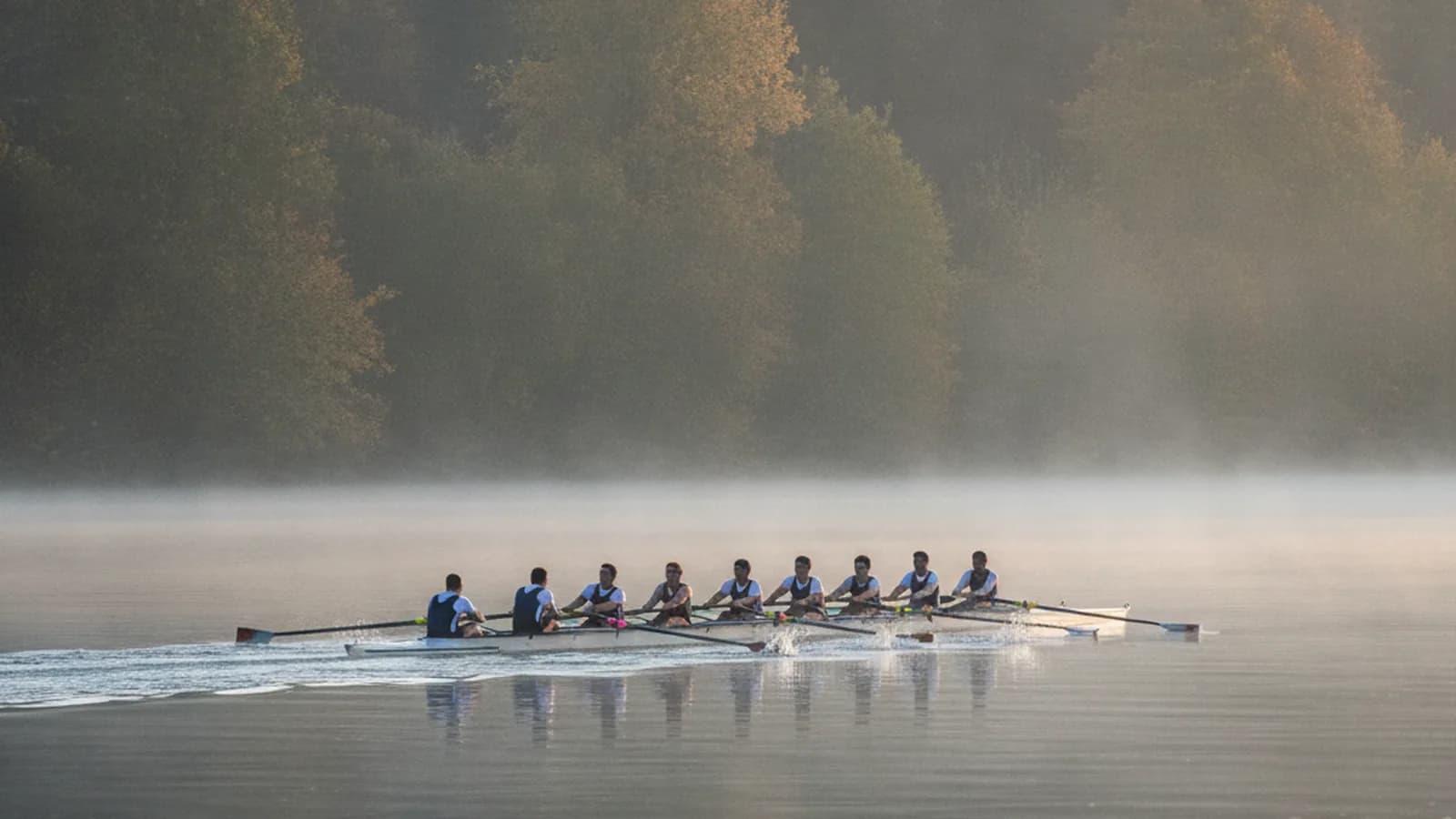
Image: AI-generated.
6 reasons for a rowing scholarship in the USA
Up to 68 places per women's team
A Division I women's rowing team may carry 68 athletes. Before 1 July 2025, the limit was 20 scholarships per team.
Teams take athletes who have never rowed
Novice groups take tall, strong athletes from other sports. Coaches teach them to row from scratch. You can join without any rowing experience.
One erg time opens the conversation
A coach asks first for your 2000 meter time on a rowing machine. You can row the test in any gym.
Learn English fast through calls in the boat
In an eight, the coxswain steers the boat and gives the calls in English. You react at once. After a few weeks, you stop translating.
Close friendships, because an eight rows as one
An eight works only when all eight rowers trust each other. Beginners learn the sport with teammates who start at the same level.
Discipline from training before sunrise
Rowing practice often starts before sunrise, and classes start right after. Four years of that rhythm abroad teach you to plan your own day.
Women's college rowing has team spots for athletes who have never rowed. Coaches first ask for your height and your 2000 meter rowing machine time.
Rowing teams and roster places by division
A team belongs to one university or college, one sport and one gender. A university or college with men's and women's soccer has two teams. We divide the roster places by the number of teams. The result is the size of a typical team in this sport.
Men
- D I51.5 Average squad size33
- D II25.3 Average squad size3
- NAIA15.5 Average squad size2
Teams, 2024-25
Women
- D I56.1 Average squad size91
- D II23.0 Average squad size14
- NAIA4.0 Average squad size2
Teams, 2024-25
| Division | Men, Teams | Women, Teams | Men, Average squad size | Women, Average squad size |
|---|---|---|---|---|
| NCAA Division I | 33 | 91 | 51.5 | 56.1 |
| NCAA Division II | 3 | 14 | 25.3 | 23.0 |
| NAIA | 2 | 2 | 15.5 | 4.0 |
What each column measures
- Division:
- Division names the association and the level of a university or college. The two NCAA levels D I and D II may give athletic scholarships. D III may not. The NAIA is a smaller second association, and it gives them too.
- Teams:
- A team belongs to one university or college, one sport and one gender. A university or college with men's and women's soccer has two teams.
- Average squad size:
- We divide the roster places by the number of teams. The result is the size of a typical team in this sport.
Roster limit, first contact and season for Rowing scholarships
Men
- Maximum squad size
- no figure reported
- Scholarship limit before July 2025
- no figure reported
- Teams
- 66
- First coach contact, school leavers of 2028
- no figure reported
Women
- Maximum squad size
- 68
- Scholarship limit before July 2025
- 20.0
- Teams
- 144
- First coach contact, school leavers of 2028
- 15 June 2026
- Competition season
- Spring season
- Ranking coaches use
- 2000 m ergometer time
What each column measures
- Maximum squad size:
- The roster limit is the most athletes a team may have in this sport. Division I, the top NCAA level, has applied it since July 2025.
- Scholarship limit before July 2025:
- This was the scholarship limit per Division I team in this sport. It applied until July 2025. Since then, the limit counts athletes instead.
- Teams:
- A team belongs to one university or college, one sport and one gender. A university or college with men's and women's soccer has two teams.
- First coach contact, school leavers of 2028:
- A college coach may write to you or answer you from this date on. It applies if you finish school in 2028. You may write to coaches before that date.
- Competition season:
- These are the months in which this sport holds its competitions in the USA. The fall season starts in August. The spring season ends in May.
- Ranking coaches use:
- Coaches in this sport use this public ranking or measured result. They compare your level with their current team.
Women's rowing scholarships per Division I team
A Division I women's rowing team may fund all 68 roster places. This applies if its university or college joined the House settlement. That court settlement from 6 June 2025 lets universities and colleges pay athletes. Before 1 July 2025, the limit was 20 scholarships per team. Men's rowing has no NCAA limit.
- Women's roster limit, Division I
- 68
- Scholarships per team before 2025
- 20
- Average Division I women's squad
- 56
Old limit outside the settlement
Division I is the top level of the NCAA. A university or college there may stay out of the House settlement. Then it keeps the old limit of 20 scholarships per women's rowing team.
Large rosters need beginners
A team with up to 68 rowers needs new athletes every year. So many teams train beginners in novice groups, which are groups for new rowers.
Funding differs inside one team
The places spread across first and second eights, fours and novice boats. An eight is a boat for eight rowers. On the same team, one rower's scholarship can be much larger than another's.
Ask where an offer places you
Ask the coach which boat an offer plans for you before you accept.
Men's rowing outside the NCAA
Men's rowing is not an NCAA championship sport. So no NCAA roster limit applies. Athletic scholarships for men are far less common.
Required level for a rowing scholarship
Rowing coaches look first at your 2000 meter time on a rowing machine. Rowers call this machine an erg. Coaches also look at your body weight. No association publishes a time standard. In women's rowing, tall athletes with an endurance background can start without rowing experience.
- Distance of the erg test
- 2000 m
- Division I women's teams
- 91
Record the test with care
Row the 2000 meter test on a calibrated machine. State the drag factor, which is the resistance setting. Be ready to repeat the test on camera.
Height and arm span count
Rowing coaches pick athletes by height and arm span. Put both in the first lines of your email.
Other endurance sports count
Results in cross country running, swimming or cycling show coaches your endurance.
Experienced rowers add boat results
If you already row, add your boat class and your crew results. Also say whether you row sweep, with one oar, or scull, with two oars.
Beginners say so in plain words
If you have never rowed, say so in plain words. Novice groups exist for this case, and coaches plan for it.
Compare with team test results
College teams publish the erg results of their squads during the season. Compare your time and weight with those results. Or ask the coach which times the squads row.
Roster places in women's and men's college rowing
Women's college rowing has 107 teams with 5,439 roster places. Men's college rowing has 38 teams with 1,807 places. Both counts cover Division I, Division II and the NAIA. Universities and colleges report these counts to the US Department of Education. Their report for 2024-25 is the EADA filing.
- Division I women's teams
- 91
- Division I men's teams
- 33
- Average Division I women's squad
- 56
Places in Division I
In Division I, the 91 women's teams have 5,109 places. The 33 men's teams have 1,700 places.
Places in Division II
In Division II, the 14 women's teams have 322 places. The 3 men's teams have 76 places.
Few teams in the NAIA
The NAIA is a separate association of smaller universities and colleges. It has 2 women's and 2 men's rowing teams.
Large squads in Division I
In 2024-25, an average Division I women's squad had 56 rowers. An average men's squad in Division I had 52 rowers.
Men race the IRA championship
The men's teams race outside the NCAA. The IRA, the Intercollegiate Rowing Association, holds their national championship.
Division III gives no athletic aid
Another 40 NCAA women's teams row in Division III. Division III gives no athletic scholarships.
Share of college rowers from abroad
In Divisions I and II, 14.7 percent of women rowers come from abroad. The NCAA register of home countries lists 3,050 rowers. Of them, 447 come from outside the United States. These rowers come from 47 countries. The register leaves out men's rowing, the NAIA and Division III.
- Division I women from abroad
- 15%
- Division II women from abroad
- 7%
- Of them from Europe
- 52%
Shares per division
In Division I, 15 percent of the women rowers come from abroad. In Division II, the share is 7 percent.
Europe and Canada
Of the rowers from abroad, 52 percent come from Europe. Another 14 percent come from Canada.
Oceania, Africa and the rest
Oceania, Africa and other regions send 31 percent of the rowers from abroad. Another 2 percent come from Latin America, and 2 percent from Asia.
Women only in the register
The register lists women's rowing only. Men's rowing is not an NCAA championship sport.
Source: NCAA register of home countries, Divisions I and II. The Athletes Personal Dashboard for rowing lists every country with its number of rowers.
Nursing and teaching degrees next to college rowing
You can study nursing or teaching and row for a college team. Both degrees include practical placements. These placements clash with the spring races over 2000 meters. Ask the department early to put them in the fall. In the fall, crews race only head races, which are longer time trials.
- Degree credit before year 3
- 40%
- Degree credit before year 4
- 60%
- Degree credit before year 5
- 80%
Nursing and teaching fix your hours
Nursing sends you to clinical placements, which means supervised hospital shifts. Teacher training ends with student teaching. That means full school days in a classroom.
Montana Tech plans around competitions
At Montana Tech, the nursing staff plan schedules with coaches ahead of time. They place athletes in clinicals and labs on days the athletes are in town.
Book classes before everyone else
Priority registration lets athletes book classes around training before other students do. Virginia Commonwealth University gives it to all athletes. Maryland's engineering school gives it to every athlete it teaches.
An adviser tracks your eligibility
Eligibility is your right to compete. An athletes' academic adviser tracks your eligibility and progress toward your bachelor's degree. The University of Denver has such an adviser, for example. The adviser also helps you pick courses that fit training and races.
Settle the degree before year 2
Division I counts only credits toward your bachelor's degree. You need 40 percent of the credits before year 3. So a late switch into nursing or teaching can put your progress at risk.
Route to the national team after college rowing
Rowing has no professional league. So after college, the route leads to your national team. Only your national federation can enter you at world championships. The 2028 Olympics in Los Angeles have 15 rowing events. Of these, 12 are classic races and 3 are beach sprints.
- Olympic rowing events in 2028
- 15
- US Olympic women from NCAA
- 24 of 24
Your federation enters you
World Rowing lets only member federations enter rowers at World Championships and World Cups. National team rowers must be citizens of that country.
Under 23 Worlds during college
You can race at the World Rowing Under 23 Championships during college. The limit is December 31 of the year you turn 22. The 2027 championships take place in Plovdiv, Bulgaria.
US Olympic women came from college
The US Olympic rowing team for Paris 2024 had 24 women. All 24 had rowed at NCAA universities and colleges, the NCAA says.
Men race the IRA championship
Men's college crews race the national championship of the IRA, the Intercollegiate Rowing Association. The IRA does not belong to the NCAA. In 2026, its championship took place on Lake Natoma, California.
Beach sprints join the Olympics
Coastal beach sprints are short races in coastal boats. They join the Olympic program at Los Angeles 2028. They make up 3 of the 15 rowing events.
Sources: World Rowing Rules of Racing (March 2025). World Rowing on the LA28 program (April 9, 2025). World Rowing on Plovdiv 2027 (August 8, 2026). NCAA (July 27, 2024). IRA (2026).
Spring rowing races in eights and fours
You race over 2000 meters in spring. Each team sends several crews in eights and fours. You are on the water before sunrise, and a race lasts about six minutes.
The team result adds up the results of all its boats. Rowing crews are often the first athletes on campus in the morning.
Former rowers talk about their crew first when they describe their four years. The races come second.

Rowing on US television and streaming
- TV networks show the women's national championship. Organizers post results from head races, where boats race against the clock. Your family can follow a season from home.
- Men's rowing has its own championships, and networks cover them less. So check what a men's program offers before you commit.
Highest-aid universities and colleges per roster place
Universities and colleges report their athletic aid for men and for women. They do not report it for each sport. So the amount per roster place covers the whole sports department.
| University or college | Division | State | Fees waived per roster place |
|---|---|---|---|
| Southern Methodist University | D I | TX | US$56,388 |
| Stanford University | D I | CA | US$42,012 |
| University of Southern California | D I | CA | US$40,006 |
| University of Miami | D I | FL | US$38,474 |
| University of Tulsa | D I | OK | US$34,797 |
| Oklahoma City University | NAIA | OK | US$34,781 |
| University of Notre Dame | D I | IN | US$34,391 |
| Duke University | D I | NC | US$34,321 |
| Syracuse University | D I | NY | US$33,068 |
| Fordham University | D I | NY | US$32,443 |
What each column measures
- Division:
- Division names the association and the level of a university or college. The two NCAA levels D I and D II may give athletic scholarships. D III may not. The NAIA is a smaller second association, and it gives them too.
- Fees waived per roster place:
- We divide the total fees waived by the roster places in the same report. A single scholarship can be much higher or much lower than this average.
Common questions about Rowing scholarships in the USA
Can I get a rowing scholarship without ever having rowed?
Why does men's college rowing have fewer scholarships than women's?
What 2000 meter erg time do I need for a rowing scholarship?
How large is a women's college rowing team?
What does a year of college rowing in the USA cost?
When do rowing coaches recruit international athletes?
Can college rowers make the Olympic team?
What does a coach want to see in a rowing video?
Rules for your athletic scholarship in the USA
Sources
Each figure comes from one of these sources. If no source reports a figure, we do not estimate one.
- U.S. Department of Education, Equity in Athletics Data Analysis (EADA) (22 August 2026)
- NCAA, DI Board of Directors formally adopts changes to roster limits (20 August 2026)
- NCAA, Question and Answer: Implementation of the House Settlement (updated 29 May 2026) (6 November 2026)
- NCAA, 2026-27 Division I Manual, Bylaw 17.2 (roster limits) (6 November 2026)
- College Sports Commission, Participating Schools (6 November 2026)
- NCAA Research, Country of Origin Spreadsheet for Student-Athletes, season 2021-22 (31 August 2026)
- NCAA, Division I Academics (progress toward degree) (12 November 2026)
- Virginia Commonwealth University, Student-Athlete Academic Services (12 November 2026)
- University of Maryland, A. James Clark School of Engineering, Engineering Student Athletes (12 November 2026)
- University of Denver, Student-Athlete Academic Services, Athletics Advising (12 November 2026)
- Montana Tech, Montana Tech students shatter myth that student-athletes can't major in nursing (2025) (12 November 2026)
- World Rowing, Rules of Racing and Related Bye-Laws, version March 2025 (entries, nationality, Rule 20) (12 November 2026)
- World Rowing, World Rowing welcomes confirmation of rowing programme and quotas for LA 2028 Olympic Games (9 April 2025) (12 November 2026)
- World Rowing, Plovdiv to host 2027 World Rowing Under 19 and Under 23 Championships (8 August 2026) (12 November 2026)
- NCAA, 100% NCAA: Meet the women's rowing team (27 July 2024) (12 November 2026)
- Intercollegiate Rowing Association, 2026 IRA National Championship at Sacramento State Aquatic Center, Lake Natoma (12 November 2026)
The editorial team of Athletic Scholarships USA writes and checks every text and figure. We are not an agency and do not place athletes at universities and colleges. When an agency would serve you better, we say so.