South
Athletic scholarships in Alabama
The University of Alabama and Auburn University run the largest athletic departments in Alabama. Living costs in Alabama are among the lowest in the US.
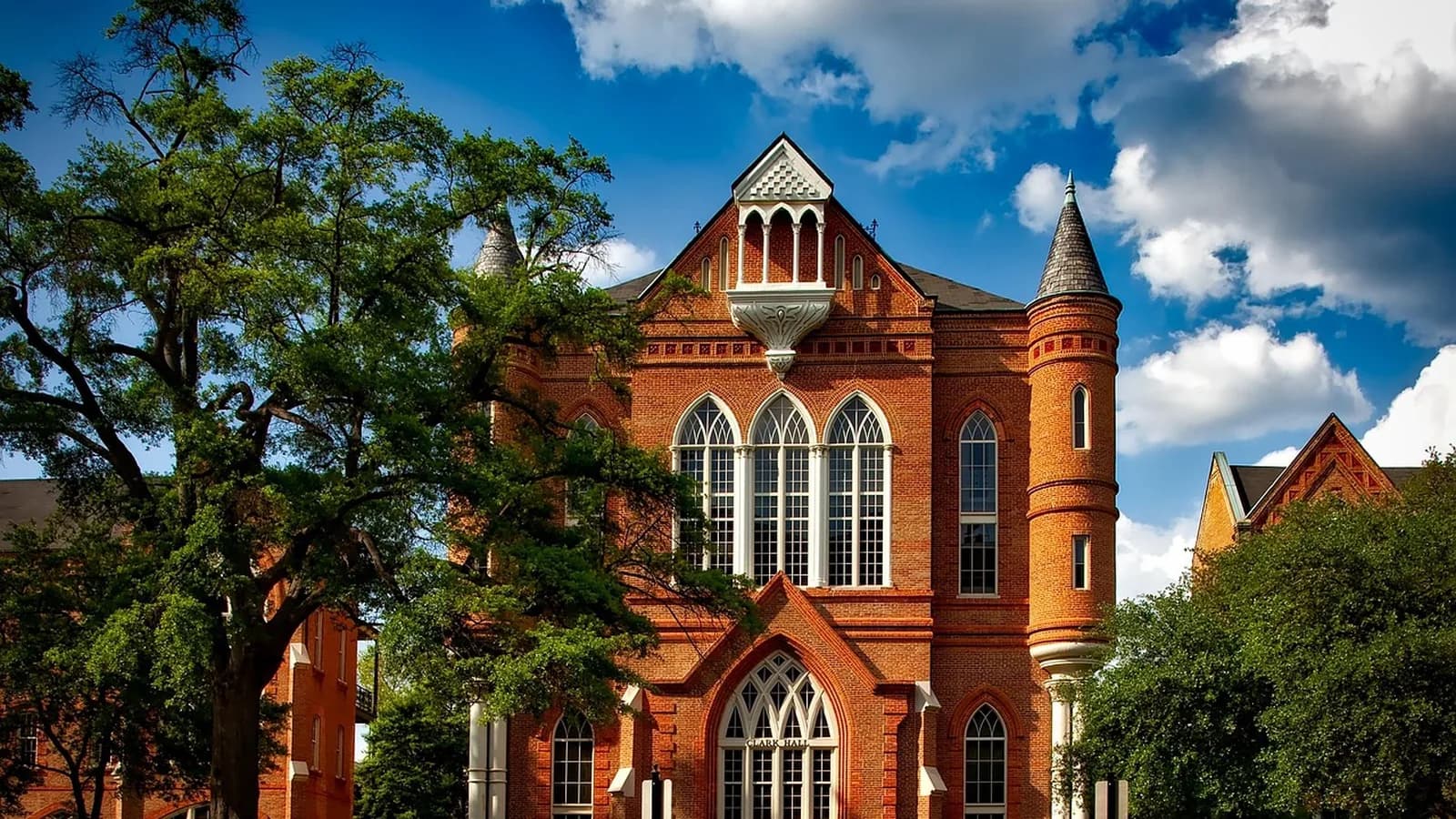
Photo: 12019, via Pixabay
Alabama, a rural state with four larger cities
Alabama lies in the southeastern US, between Mississippi and Georgia. It has a short coast on the Gulf of Mexico.
Its larger cities are Birmingham, Huntsville, Montgomery and Mobile. Outside them, most of the state is rural.
Alabama's airports have no direct flights from Europe. You change planes on the way, for example in Atlanta in neighboring Georgia.
Montgomery and Selma are places where the civil rights movement made history. In Montgomery, you can visit the Dexter Avenue Baptist Church. Martin Luther King preached in this church.
Selma has the Edmund Pettus Bridge. Marchers for voting rights crossed it on their way to Montgomery.
University towns, Birmingham, Huntsville and the Gulf Coast
Your university or college decides where you live in Alabama. You live in a small university town, a mid-sized city or on the coast.
- Tuscaloosa and Auburn
- The University of Alabama in Tuscaloosa and Auburn University compete in Division I. Division I is the top level of the NCAA. Both towns are small, safe and cheap to live in. Home football games set the local calendar every fall.
- Birmingham and Huntsville
- Birmingham is the largest metro area in Alabama. It has the University of Alabama at Birmingham. Samford University lies in the suburb of Homewood. Huntsville has NASA's Marshall Space Flight Center and aerospace employers. The University of Alabama in Huntsville is there too.
- Mobile and the Gulf Coast
- Mobile is a port city on the Gulf of Mexico. It has the University of South Alabama and Spring Hill College. The University of Mobile is there too. Mobile is the warmest and most humid part of Alabama. Hurricanes can reach it from June to November.
Costs, heat, transport and people in Alabama
Living costs among the lowest in the US
Rent, food and everyday costs in Alabama are below the US average. A partial scholarship goes further in Alabama than in most other states.
Hot, humid summers from June to September
From June to September, heat and humidity make outdoor training in the afternoon hard. Most teams train in the early morning or evening for much of the year.
You need a car outside the university towns
Outside the larger cities, Alabama has little public transport. Without a car of your own, you depend on teammates who have one.
Few other international students
People in Alabama tend to welcome newcomers. Few international students study in Alabama. The nearest student from your country may be at another university or college.
Alabama's universities and colleges pay more athletic aid per roster place than most states. Few international students study in Alabama.
45 universities and colleges with sports in Alabama
The table sorts the universities and colleges in Alabama by division. Four-year universities and colleges make up 22 of them. NCAA Division I is the top level. Only NCAA Division I, NCAA Division II and the NAIA may give athletic scholarships. NCAA Division III may not.
| Division | University or college | Roster places | Fees waived in total | University or college |
|---|---|---|---|---|
| NCAA Division I | 10 | 5,280 | US$89,477,055 | |
| NCAA Division II | 7 | 2,831 | US$18,503,358 | |
| NAIA | 5 | 1,249 | US$12,109,264 |
What each column measures
- Division:
- Division names the association and the level of a university or college. The two NCAA levels D I and D II may give athletic scholarships. D III may not. The NAIA is a smaller second association, and it gives them too.
- Roster places:
- A roster place is one athlete's spot on a team for one season. An athlete who competes in two sports fills two roster places.
- Fees waived in total:
- This is all athletic aid the universities and colleges report for one academic year. Most of it is a discount on their own tuition, housing and meal bills.
US$12,830 athletic aid per roster place in Alabama
We add up all athletic aid in Alabama. Then we divide it by the number of roster places. A roster place is one spot on a team for one season. Across all states, the figure is US$11,640.
US$120,089,677
Fees waived in total
US$12,830
Fees waived per roster place
All states: US$11,640
9,360
Roster places
Out-of-state students in Alabama pay US$10,440 more yearly
International students pay the out-of-state rate at public universities and colleges. A full scholarship covers this rate. With a partial scholarship, you pay part of it yourself. The figure is a median. It covers 13 four-year public universities and colleges in Alabama. All of them may give athletic aid.
US$11,248
In-state tuition
US$22,320
Out-of-state tuition
US$10,440
Out-of-state surcharge
Of 22 four-year universities and colleges, 22 reported this figure.
Alabama's two largest athletic departments
- The University of Alabama and Auburn University
- The University of Alabama and Auburn University run Alabama's two largest athletic departments. Both play in the Southeastern Conference, or SEC. The SEC is a league of large universities and colleges. Most of its members are in the South. Both have teams in many sports besides football.
Baseball has the most programs in Alabama
American football is the biggest sport at the University of Alabama and Auburn University.
Universities and colleges in Alabama also offer baseball, softball and track and field. The warm climate allows outdoor training for most of the year.
The table counts universities and colleges per sport. A university or college with men's and women's teams in one sport counts once.
| Sport | Universities and colleges with a team | Universities and colleges with a team |
|---|---|---|
| Baseball | 22 | |
| Basketball | 22 | |
| Softball | 22 | |
| Volleyball | 22 | |
| Track and cross country | 21 | |
| Soccer | 19 | |
| Golf | 17 | |
| Tennis | 16 | |
| American football | 14 | |
| Bowling | 6 | |
| Beach volleyball | 5 | |
| Swimming and diving | 3 |
What each column measures
- Universities and colleges with a team:
- Each university or college counts once per sport. This holds even if it has a men's and a women's team. Only NCAA Division I and II and the NAIA count. Division III gives no athletic scholarships.
1.7% of students in Alabama have no US status
In Alabama, 1.7% of all undergraduates have no US status. This share counts students at all 45 universities and colleges in the state. Across all states, the share is 3.5%.
1.7%
Share of international students
All states: 3.5%
197,145
Undergraduates
Alabama averages 7.4 °C in January, 26.9 °C in July
NOAA, the US weather agency, worked out these averages for all of Alabama. They cover the years 1991 to 2020. The yearly average is 17.6 °C. Rain and snow add up to 1,445 mm a year.
7.4 °C
Average temperature in January
26.9 °C
Average temperature in July
17.6 °C
Average annual temperature
1,445 mm
Annual precipitation
Small-town isolation and August heat in Alabama
Small campuses feel isolated without a car
A small campus in Alabama can feel isolated if you have no car. It feels worse when nobody from your country is on the team. Ask an international athlete on that campus how they spend a free weekend.Heat and humidity in August training
In Alabama's summer, heat and humidity together slow your recovery. You also need to drink more. Ask the coach how the team plans training in August.Alabama universities and colleges ranked by athletic aid
The table sorts the universities and colleges by athletic aid per roster place. Each row links to the figures for each sport.
| University or college | City | Division | Roster places | Fees waived per roster place | Fees waived per roster place |
|---|---|---|---|---|---|
| Auburn University | Auburn | D I | 667 | US$28,233 | |
| Samford University | Birmingham | D I | 503 | US$20,864 | |
| The University of Alabama | Tuscaloosa | D I | 828 | US$20,760 | |
| University of Alabama at Birmingham | Birmingham | D I | 470 | US$17,655 | |
| University of Mobile | Mobile | NAIA | 399 | US$17,328 | |
| University of South Alabama | Mobile | D I | 503 | US$15,705 | |
| Jacksonville State University | Jacksonville | D I | 498 | US$14,761 | |
| Auburn University at Montgomery | Montgomery | D II | 209 | US$13,718 | |
| Troy University | Troy | D I | 486 | US$13,487 | |
| University of North Alabama | Florence | D I | 358 | US$13,402 | |
| University of West Alabama | Livingston | D II | 384 | US$11,323 | |
| Faulkner University | Montgomery | NAIA | 353 | US$11,198 | |
| Alabama State University | Montgomery | D I | 417 | US$8,418 | |
| Alabama A & M University | Normal | D I | 550 | US$8,274 | |
| Spring Hill College | Mobile | D II | 339 | US$7,824 | |
| University of Alabama in Huntsville | Huntsville | D II | 552 | US$5,175 | |
| University of Montevallo | Montevallo | D II | 656 | US$4,698 | |
| Miles College | Fairfield | D II | 274 | US$4,563 | |
| Tuskegee University | Tuskegee | D II | 417 | US$3,470 | |
| Oakwood University | Huntsville | NAIA | 112 | US$3,125 | |
| Stillman College | Tuscaloosa | NAIA | 161 | US$2,712 | |
| Talladega College | Talladega | NAIA | 224 | US$2,035 |
6 questions about athletic scholarships in Alabama
Is Alabama a suitable state for international student athletes?
Which cities in Alabama have universities and colleges that give athletic scholarships?
How many universities and colleges in Alabama can offer an athletic scholarship?
What does a year in Alabama cost without a scholarship?
How many international students study in Alabama?
Which sport do the most universities and colleges in Alabama offer?
Sources
Each figure comes from one of these sources. If no source reports a figure, we do not estimate one.
- U.S. Department of Education, Equity in Athletics Data Analysis (EADA) (22 August 2026)
- U.S. Department of Education, College Scorecard (23 August 2026)
- NOAA National Centers for Environmental Information, Climate at a Glance (21 August 2026)
The editorial team of Athletic Scholarships USA writes and checks every text and figure. We are not an agency and do not place athletes at universities and colleges. When an agency would serve you better, we say so.