Rules checked on: 23 August 2026
Types of US universities and colleges
US universities and colleges differ in highest degree, size, location and control. Control means public or private ownership. The highest degree affects your daily life the least.
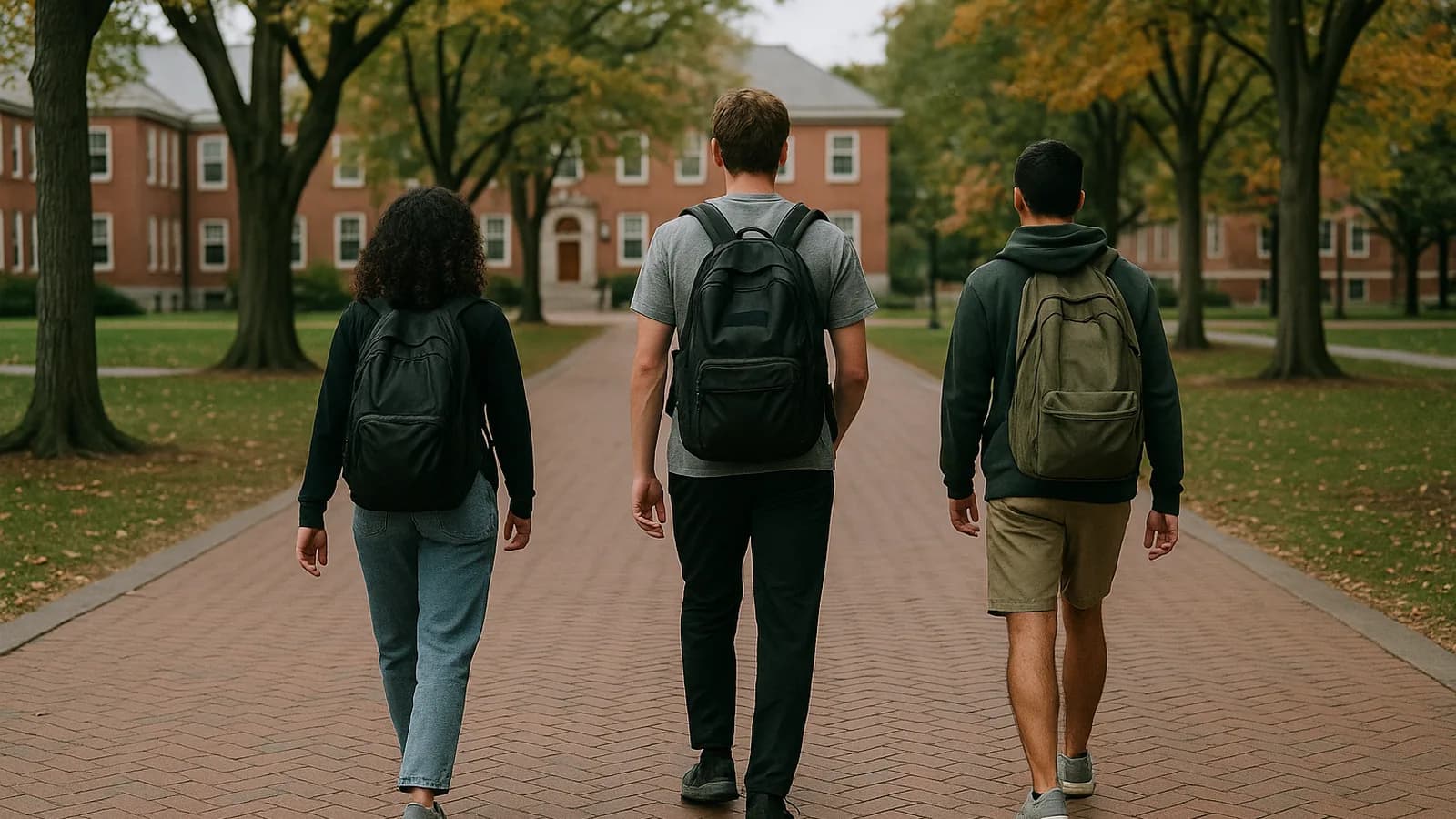
Image: AI-generated.
Large and small universities and colleges compared
A large university or college offers more subjects and more research. Its sports program often competes in the top division.
First-year courses there can have three hundred students. You have to organize academic help yourself.
A small university or college has smaller classes and easy-to-reach teachers. Its athletic department knows your name.
But it offers fewer subjects. In most cases, it competes in a lower division, a lower level of competition.
Say you come from abroad and know nobody in your first year. Then you notice this difference every day.
Public universities and colleges charge you out-of-state rates
Public universities and colleges are cheap for residents of their own state. As an international student, you always pay the out-of-state rate. It is often two to three times as much.
Private universities and colleges have higher list prices. But they give more discounts and academic scholarships.
So a private university or college with a high list price can be cheaper. A public one with a low list price can cost you more.
Always compare what you pay after your scholarship offer. Never compare list prices.
Campus location decides life without a car
Large universities and colleges are often in or near cities. Cities have buses, part-time jobs and internships.
Small universities and colleges are often in small towns or in the countryside. There you can walk to everything that matters. Everything else is an hour away by car.
Location is the most practical question for an international first-year student without a car. In the countryside, you need rides and long drives to competitions and the airport.
In return, you get to know your team faster. You also pay much less to live there.
Both kinds of location can suit you. Know which one you are choosing before you accept an offer.
Compare two universities or colleges by what you pay after your scholarship offer.
4 university and college types by highest degree
| Type | Highest degree | Years to first degree | What it means for sport |
|---|---|---|---|
| University | Doctorate | 4 | Universities have the largest sports programs and the highest divisions in most cases. Their first-year courses can have three hundred students. |
| Four-year college | Bachelor | 4 | Four-year colleges are smaller and often compete in the second or third division. Coaches and teachers are easy to reach. |
| Liberal arts college | Bachelor | 4 | Liberal arts colleges teach a broad range of subjects in small classes. Most of them compete in the third division. So they give no athletic scholarships. |
| Community college | Associate | 2 | Community colleges lead to an associate degree in two years and cost much less. Their sport runs in a separate system with its own associations and rules. |
Student counts from under 1,000 to over 10,000
The official classification counts full-time equivalents, so two half-time students count as one. Size decides how many people sit in your classes. It also decides if a lecturer notices when you are absent.
| Size class | Students | What you notice |
|---|---|---|
| Very small | under 1,000 | Everybody knows everybody, and the coach sees you every day. The choice of subjects is narrow. |
| Small | 1,000 to 2,999 | Classes have about twenty students, and the lecturer knows your name. The choice of subjects is manageable. |
| Medium | 3,000 to 9,999 | First-year lectures are large, and classes in your major are small. |
| Large | 10,000 and above | First-year courses have three hundred students, and every subject is on offer. You have to find help yourself. |
50% or more live on top residential campuses
The Carnegie Classification also measures how many students live on campus. On a commuter campus, most students live elsewhere. So the campus is empty in the evening. As a first-year student from abroad, you know nobody yet.
- Highly residential
- At least 50% of students live on campus. At least 80% of them study full time. The campus stays busy on weekends too.
- Primarily residential
- Between 25% and just under half of students live on campus. At least half study full time. On weekends, some students stay and the others go home.
- Commuter campus
- Fewer than 25% of students live on campus. Or fewer than half study full time. The campus empties after the last class of the day.
Source: Carnegie Classification, Size and Setting (size classes and residential character), 23 August 2026
1,892 public universities and colleges, 1,754 private non-profit
Control means whether a state or a private owner runs the university or college. It decides what a year costs and how far it can lower your price. For international students, public universities and colleges lose their price advantage.
| Control | Colleges | What it means for you |
|---|---|---|
| Public | 1,892 | Residents of the state pay little. You always pay the out-of-state rate, often two to three times as much. |
| Private, non-profit | 1,754 | The list price is high. But these universities and colleges give the most discounts and academic scholarships. Most small colleges belong to this group. |
| Private, for-profit | 2,270 | This is the largest group by number, and it matters least for you. These universities and colleges run almost no sports programs. Many of them give no bachelor's degree. |
Counts for 2020-21, all universities and colleges that may receive federal student aid. NCES, Fast Facts: Educational institutions (number and control, 2020-21), 23 August 2026
4 official campus locations from city to countryside
The Department of Education assigns every campus one of four location types. The location shapes your daily life more than its size. Without a car, it decides almost everything.
| Location | What a day looks like | What to watch for |
|---|---|---|
| City | You travel by bus and train and find part-time jobs and internships. You spend part of your time off campus. | Rent and living costs are higher, and the campus empties in the evening. |
| Suburb | The campus is quiet. You reach the city by one bus line or a short drive. | Without a car, you depend on the bus schedule. The last bus leaves earlier than you think. |
| Town | The town depends on the university or college. You can walk to everything that matters. Everything else takes an hour by car. | The town has few part-time jobs and few internships. The nearest airport is far away. |
| Rural | Only countryside lies near the campus. Your team becomes your main social circle. | Without a car or a ride, you cannot leave. Plan the cost of trips to competitions and of flights home. |
The location types are official. The two right-hand columns come from experience and do not come from statistics. NCES, Locale Classifications and Criteria (City, Suburb, Town, Rural), 23 August 2026
Types of institution: rules and application steps
The type of university or college often decides the association. Many small private colleges belong to the NAIA. The large universities compete in the NCAA. Each association has its own scholarship rules.
Rules with source and check date
Application steps with their dates
Common questions about athletic scholarships in the USA
How large is an American university or college?
How does daily life differ at a city campus and a rural campus?
What is the difference between public and private US universities and colleges?
Does a university always compete at a higher level than a college?
What is the Ivy League?
How do I tell the type of a US university or college?
3 more topics on studying in the USA
Sources
Each figure comes from one of these sources. If no source reports a figure, we do not estimate one.
- NCES/IPEDS, glossary of award levels and institutional categories (23 August 2026)
The editorial team of Athletic Scholarships USA writes and checks every text and figure. We are not an agency and do not place athletes at universities and colleges. When an agency would serve you better, we say so.