Updated on: 11 November 2026
US degree recognition in your home country
Who recognizes your US bachelor's degree depends on its use. A university or college decides on a master's place. An employer decides on a job. A national authority decides on a regulated profession.
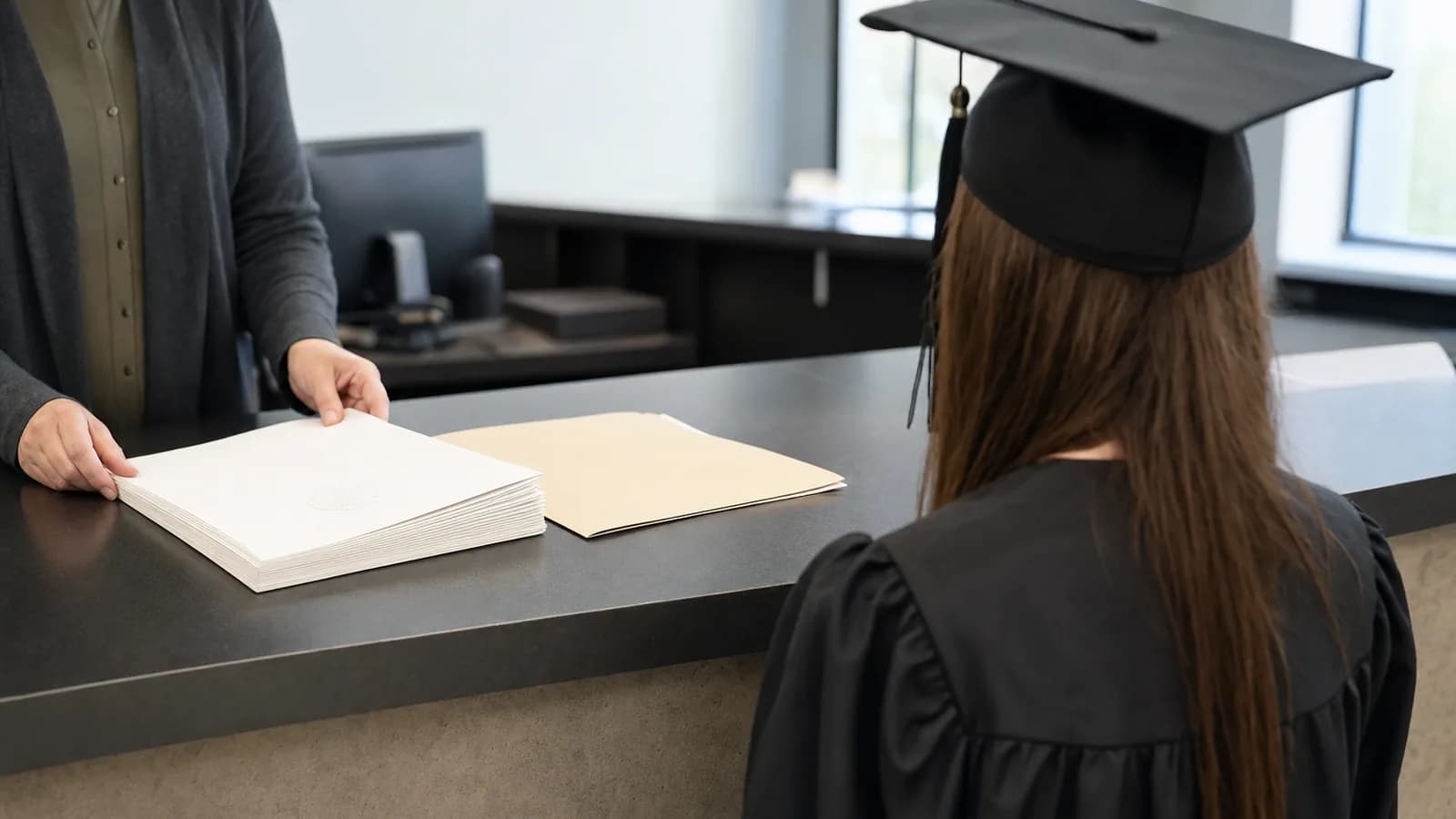
Image: AI-generated.
Degree recognition in 3 key points
Accreditation of your university or college comes first
No federal authority in the United States controls universities and colleges. Private accrediting agencies check them. The US Department of Education recognizes these agencies. The Department's DAPIP database shows if an agency accredits your university or college.
An apostille certifies the diploma for use abroad
An apostille confirms a US document for use in another country. A US state's secretary of state issues the apostille for that state's documents. Your country needs an apostille if it belongs to the Apostille Convention. The UK, Sweden, Norway and Poland belong to it. Canada has belonged to it since January 11, 2024.
Separate decisions for study, jobs and licenses
A university or college decides on a master's place. An employer decides on a job. A national authority decides on a regulated profession. Your ENIC-NARIC center, the national office for foreign qualifications, helps with the first two.
Recognition starts with accreditation in the USA
Recognition starts with the accreditation of the university or college that gave your degree. The US Department of Education says no federal ministry controls US universities and colleges. So private accrediting agencies check them.
Institutional accreditation covers a whole university or college. Programmatic accreditation covers one program, such as engineering or nursing.
The Department recognizes these agencies. Its database DAPIP lists every university or college they accredit.
Since 1 July 2020, the Department no longer separates regional from national accreditation. The legal source is 84 FR 58834.
Some people claim that regional accreditation is the better kind. That claim has no official basis.
UK ENIC is the British recognition center. It accepts only qualifications with official recognition in the country of study. For a US degree, accreditation is that proof.
Check your university or college in DAPIP before you sign anything. Nobody at home can repair a missing accreditation later.
Apostille and transcript prove your degree abroad
An apostille confirms a public document for use in another member country. The member countries belong to the Hague Apostille Convention of 1961. USA.gov lists diplomas among the documents that can need one.
A US state's secretary of state issues the apostille for state documents. The US Department of State issues it for federal documents.
The Hague Conference lists the member countries. Members include Germany, Spain, the United Kingdom, Sweden, Norway, Poland, Canada and the USA. Canada has been a member only since January 11, 2024.
A country outside the convention asks for an authentication certificate instead of an apostille.
You also need the official transcript. It is the certified record of every course and grade. Penn State, for example, issues a secured PDF or sealed, signed paper.
The registrar is the records office of your university or college. Before you leave, ask the registrar about the apostille. Also order several official transcripts.
ENIC-NARIC centers compare your US degree
Your national ENIC-NARIC center is the first office for a US degree at home. The Lisbon Recognition Convention is the European treaty on recognizing higher education.
The ENIC network joins the centers of 54 parties to this convention. The NARIC network joins the centers of 34. Each center informs and advises on recognition.
Some countries let their center make recognition decisions that bind by law. Others limit it to advice or a recommendation. Ask your center which it does before you rely on its document.
UK ENIC issues a Statement of Comparability. It compares foreign qualifications with the UK system for jobs, study or professional registration. The statement costs £69.60 with an e-Statement.
It takes up to 15 working days from complete documents and payment. Professional licenses and qualifications from professional bodies are in most cases not eligible.
Three decisions for master's, job and profession
For a master's program, the university or college you apply to decides. It checks if your bachelor's degree meets its entry conditions. It also decides which documents it wants.
Outside the regulated professions, the employer decides what your degree is worth. A statement from your ENIC-NARIC center gives the employer a reference point.
In a regulated profession, only people with a recognized qualification may work. Examples in many countries are medicine and school teaching.
A national authority or professional body decides by its own rules. A comparison statement alone is not enough. Ask that authority before you choose your major.
An American bachelor's degree takes 4 years. In most cases, it needs 120 credits. General education fills the first two years with broad courses across several subjects.
So a specialized master's program at home may check your credits in its subject.
5 steps to recognition of a US degree
Each row names one step, as of November 2026. It says what the step is and who issues or decides it. It also says when you deal with it.
| Step | What it is | Who issues or decides | When |
|---|---|---|---|
| Accreditation | Proof that a recognized agency accredits the university or college | Accrediting agency, listed in the Department of Education's DAPIP database | Before you accept an offer |
| Official transcript | Certified record of every course and grade | Registrar of your university or college | Before graduation, several copies |
| Apostille | Certificate that confirms the diploma for use abroad | Secretary of state of the issuing state. For federal documents, the US Department of State | Before you leave the USA |
| Comparison statement | Statement of how your degree compares with the system at home | National ENIC-NARIC center. UK ENIC charges £69.60 | When an employer or a university or college asks for it |
| Professional recognition | Permission to work in a regulated profession | National authority or professional body | Before you choose your major |
Recognition of a US bachelor's degree starts with an accredited university or college. No office at home can repair a missing accreditation later.
Degree recognition: rules and application steps
Your choice of university or college decides the accreditation of your degree. Degree copies need the same certification as school records. Your F-1 visa sets how long you may stay after graduation.
Rules with source and check date
Application steps with their dates
Common questions about athletic scholarships in the USA
Is a US degree recognized in the UK?
Which universities and colleges in the US are not accredited?
Do I need an apostille for my US college diploma?
What does an ENIC-NARIC center do with a US degree?
Can WES evaluate my US degree for recognition in Europe?
Does a US degree count for a regulated profession at home?
More guides on athletic scholarships
Sources
Each figure comes from one of these sources. If no source reports a figure, we do not estimate one.
- U.S. Department of Education, Accreditation in the U.S. (11 November 2026)
- Department of Education, Final Rule on the Recognition of Accrediting Agencies, 84 FR 58834 (11 November 2026)
- Department of Education, Database of Accredited Postsecondary Institutions and Programs (11 November 2026)
- U.S. Department of Education, Recognition of Foreign Qualifications (11 November 2026)
- USA.gov, Authenticate an official document for use outside the U.S. (11 November 2026)
- HCCH, Status table of the Apostille Convention (11 November 2026)
- Penn State Registrar, Official Transcripts (11 November 2026)
- ENIC-NARIC Networks, About the ENIC and NARIC Networks (11 November 2026)
- UK ENIC, Statement of Comparability (11 November 2026)
- UK ENIC, Statement of Comparability: cost (11 November 2026)
- World Education Services, Credential Evaluations (11 November 2026)
- ZAB (KMK), Zeugnisbewertung: Häufige Fragen (11 November 2026)
- ZAB (KMK), Zeugnisbewertung: Antrag (11 November 2026)
- anabin (KMK), Rechercheanleitung Hochschule (11 November 2026)
- Anerkennung in Deutschland, Berufliche Anerkennung (11 November 2026)
- Anerkennung in Deutschland, Anerkennung für ein Studium (11 November 2026)
- BOE, Real Decreto 889/2022, homologación y equivalencia de títulos universitarios extranjeros (11 November 2026)
- Ministerio de Ciencia, Innovación y Universidades, Cómo reconocer un título extranjero (11 November 2026)
- Ministerio de Ciencia, Innovación y Universidades, Tasa (11 November 2026)
- Ministerio de Ciencia, Innovación y Universidades, Cierre de la subsede electrónica de la Secretaría General de Universidades (22.10.2026) (11 November 2026)
- Ministerio de Ciencia, Innovación y Universidades, Proyecto de Real Decreto de reconocimiento y verificación académica y profesional de las titulaciones universitarias oficiales obtenidas en sistemas universitarios extranjeros (11 November 2026)
- BOE, Real Decreto 265/2026, estructura orgánica del Ministerio de Ciencia, Innovación y Universidades (11 November 2026)
- DHS, final rule on a fixed time period of admission (20 August 2026)
- DHS, Establishing a Fixed Time Period of Admission (Final Rule), 91 FR 44976 (6 November 2026)
- NAFSA, Legal Challenge to the Final Rule Ending Duration of Status (6 November 2026)
- Study in the States, final rule FAQ (20 August 2026)
- Ogletree Deakins, analysis of the final rule (20 August 2026)
The editorial team of Athletic Scholarships USA writes and checks every text and figure. We are not an agency and do not place athletes at universities and colleges. When an agency would serve you better, we say so.