Updated on: 3 November 2026
Eligibility for college sport after a bachelor's degree
The five NCAA years start with your first full-time university or college term. That is often the first term of your bachelor's degree. To compete in a later master's program, you need two things. A US graduate school must admit you, and your five-year clock needs time left.
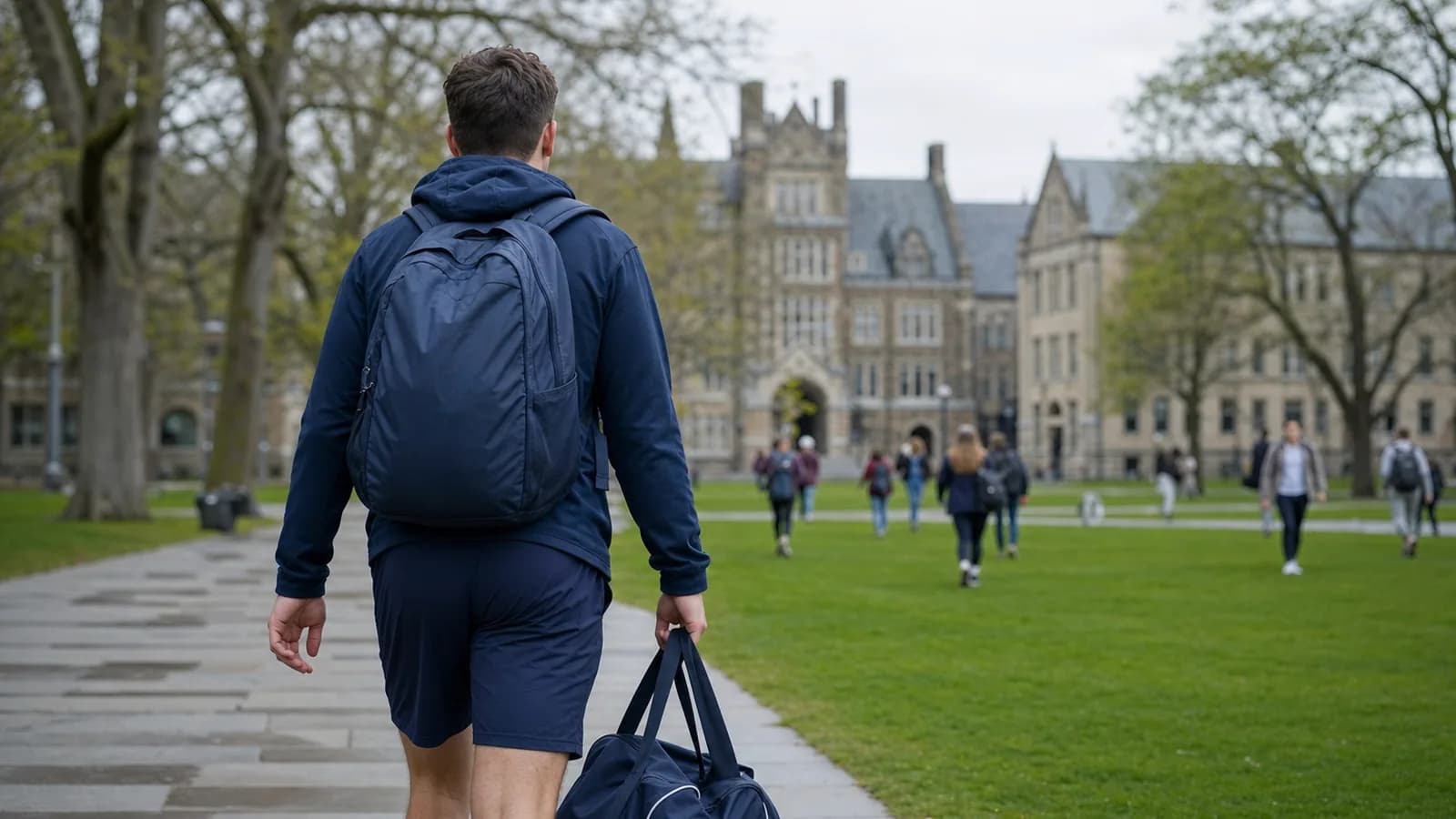
Image: AI-generated.
After the bachelor's degree in 3 key points
Admission and eligibility left after the bachelor's
The graduate school decides whether it admits you. The NCAA or the NAIA decides whether you may compete. They are the two big US college sports associations. A coach who wants you on the team cannot replace either decision.
NCAA clock starts with your first full-time term
In NCAA Division I and II, you have five years to compete. They start with your first full-time term at any university or college worldwide. The academic year after your nineteenth birthday starts them if that comes first. A three-year bachelor's degree from home uses three of the five years.
Three-year degrees at US graduate schools
Syracuse University accepts three-year bachelor's degrees from Bologna countries as US equivalents. Bologna countries are European countries with a shared bachelor and master system. The University of Rhode Island accepts one only after a course-by-course evaluation. Each graduate school sets its own rule.
Graduate school admission and eligibility for a master's
A master's in the United States is a graduate degree. The graduate school of a US university or college decides on admission. It runs the master's and doctoral programs, with its own application and entry conditions.
The athletics department has no say in that decision. The second permission is eligibility, the right to compete for a college team.
In NCAA Division I, you may compete as a graduate student under two conditions. You study full time in a graduate or professional program with eligibility left. Division II asks for the same two things.
The NAIA is a smaller second association. There, a student with a bachelor's degree counts as a post-baccalaureate student. That student may compete with a full-time load, as the graduate school defines it.
The cumulative grade average must also reach 2.0 on the 4.0 scale.
The NCAA five-year clock since 2026
The NCAA is the largest US college sports association. Since 2026, it counts eligibility as a period of time. Before, it counted seasons played.
Division I adopted this age model on 24 June 2026. Division II applies it from the 2026-27 academic year.
You have five years of eligibility. They start at the earlier of two dates.
The first date is your first full-time term at any university or college. A term outside the United States counts too.
The second date is the start of the academic year after your nineteenth birthday. The clock keeps running through a year out, injury or a season without competition.
From fall 2027, Division I uses only the age model. It applies to all new full-time students. Athletes who enrolled earlier get whichever model favors them, old or new.
Years left after a European bachelor's degree
Say you started a three-year bachelor's degree at nineteen and finished on time. Then three of your five NCAA years are gone and two remain.
Two years cover most master's programs. Most of them run one to two years.
Say you started at twenty after a year out. Then the age rule started the clock a year earlier. Only one year remains when you arrive.
The compliance office is the athletics staff that checks eligibility rules. At the US university or college, it decides one question. Does your first European enrollment count under the old or the new model?
NAIA seasons and semesters for graduates
The NAIA, a smaller second association, has its own rules. Its 2026-27 handbook allows four seasons in one sport within ten full-time semesters.
A year at a university or college abroad counts as two semesters. So a three-year bachelor's degree from home uses six of the ten.
The NAIA counts seasons apart from semesters. You use a season when you compete for a college team. From the thirteenth month after you left school, professional-level competition also uses a season.
A league counts as professional level if it calls itself professional. A semi-professional league counts too if it pays more than travel, meals and lodging. Amateur club sport at home uses no season.
Fifth NAIA season from fall 2027
NAIA members approved a fifth season on 4 November 2026. It applies from fall 2027 and needs a set number of credit hours. The ten-semester limit stays.
An expired NCAA clock does not by itself end your NAIA eligibility. The NAIA Eligibility Center tells you what applies to you. You register with it apart from the NCAA.
Three-year European bachelor's degrees at US graduate schools
A US bachelor's degree takes four years. It starts with two years of general education.
General education means required courses across every area. Most European bachelor's degrees take three years in one subject.
So each graduate school decides if a three-year degree is enough for a master's.
Syracuse University treats three-year Bologna Process degrees as equal to a US bachelor's degree. The Bologna Process is Europe's shared system of bachelor and master degrees.
The University of Rhode Island first wants a course-by-course credential evaluation. It must show that the three-year degree equals a four-year US degree.
A credential evaluation is a report by a recognized service. It translates your courses and grades into US terms. Ask the graduate admissions office of each program before you talk to a coach.
Fifth-year master's after a US bachelor's degree
A US bachelor's degree takes four years, and the NCAA clock runs five. So an athlete who graduates on time still has a year. Many use it for a master's at their own or another university or college.
Credit brought from school or earned in summer courses can shorten the bachelor's degree. It then leaves more of the five years for a master's.
Graduate transfers in Division I
A graduate transfer moves to another Division I university or college for a master's. You must hold your degree and leave with academic eligibility. You must also enroll full time as a graduate student.
You announce the move through the transfer portal. That is the NCAA database for athletes who want to change universities or colleges.
A graduate student may enter the portal at any time in the academic year. The entry must come before the sport's last transfer window closes.
A graduate transfer takes a roster place like any other athlete. Since 2025, many Division I universities and colleges cap their team sizes. So a coach compares a graduate student with college results to a first-year recruit.
Undergraduate transfer without a finished bachelor's degree
Maybe you started a degree at home and did not finish it. Then you have no bachelor's degree and cannot start a master's. You apply to a US university or college as an undergraduate transfer.
The US university or college decides which courses count toward its bachelor's degree. Your first full-time term at home started the NCAA five-year clock. This is true even if you never competed there.
The NAIA counts each year abroad as two of your ten semesters. Any season with a college team or at professional level counts too.
Register with the NCAA Eligibility Center. That office certifies international athletes for Division I and II. Have your home university or college send its transcripts straight to the Eligibility Center.
Without these papers, nobody can say how much eligibility and credit you have. That goes for the US university or college and for the association.
Eligibility left after the bachelor's, by starting situation
Each row assumes a degree finished on time and no professional competition. The years follow from the NCAA five-year clock and the NAIA ten-semester rule. The compliance office of the university or college confirms each case.
| Starting situation | Degree level in the USA | Eligibility left in the typical case | Clarify first |
|---|---|---|---|
| Three-year bachelor's from home, started at nineteen | Master's, as a graduate student | NCAA: about two of five years. NAIA: four of ten semesters | Whether the graduate school accepts a three-year degree |
| Three-year bachelor's from home, started at twenty after a year out | Master's, as a graduate student | NCAA: about one year, because the age trigger started the clock. NAIA: four semesters, because the year out was no term | Whether one year covers the length of the program |
| Four-year bachelor's from home | Master's, as a graduate student | NCAA: about one year at most. NAIA: two semesters | Whether one year of eligibility matches a one-year master's |
| US bachelor's finished in four years | Master's at the same or another university or college | NCAA: one year. NAIA: two semesters, if seasons remain | For a Division I move, the transfer portal before the sport's last window |
| US bachelor's finished early with transfer credit | Master's at the same or another university or college | NCAA: the years the bachelor's degree did not use, up to five in total | Whether the graduate program fits into the remaining years |
| Degree started at home and not finished | Bachelor's, as an undergraduate transfer | NCAA: the clock has run since the first full-time term. NAIA: each year abroad counts as two semesters | Which courses the US university or college credits, and registration with the Eligibility Center |
The NCAA five-year clock starts with your first full-time university or college term. That includes one in your home country.
After the bachelor's degree: rules and application steps
The five-year clock decides how much time you have left. The transfer rules govern a move to another university or college for a master's.
Rules with source and check date
Application steps with their dates
Common questions about athletic scholarships in the USA
Can I compete in a US master's program after a three-year European bachelor's degree?
Do my years at a European university or college count against my NCAA eligibility?
Can a graduate student compete for an NAIA university or college?
Can a college athlete switch Division I universities or colleges for a master's degree?
Can I enter a US graduate school without a finished degree from home?
How long does a master's degree in the USA take?
More guides on athletic scholarships
Sources
Each figure comes from one of these sources. If no source reports a figure, we do not estimate one.
- NCAA, Division I and Division II age-based eligibility rules (3 November 2026)
- NCAA, Division I adopts age-based eligibility model (3 November 2026)
- NCAA, Division I Council approves changes to transfer rules (graduate transfers) (3 November 2026)
- NCAA Eligibility Center, Guide for Four-Year Transfers 2025-26 (3 November 2026)
- NAIA, Official & Policy Handbook 2026-2027 (3 November 2026)
- NAIA, legislation 26-B-01 on five seasons of competition, adopted 4 November 2026 (3 November 2026)
- Syracuse University, Equivalence of a U.S. Bachelor's Degree (3 November 2026)
- University of Rhode Island Graduate School, international applicants (3 November 2026)
- NCAA, Division II adopts age-based eligibility model (20 October 2026)
- NCAA, 2026-27 Division I Manual, Bylaw 12.6 (five-year period) (6 November 2026)
- NCAA, 2026-27 Division II Manual, Bylaw 14.4.3 (five-year period) (6 November 2026)
- AP, Schools are snatching up transfers in college hoops. That means fewer freshmen on D-I rosters, too (NCAA data, 2 November 2023) (11 November 2026)
The editorial team of Athletic Scholarships USA writes and checks every text and figure. We are not an agency and do not place athletes at universities and colleges. When an agency would serve you better, we say so.