Updated on: 11 November 2026
From junior college to an NCAA scholarship
A junior college is a two-year US college. There, you play two seasons and earn an associate degree. Then you move to a university or college in NCAA Division I or II.
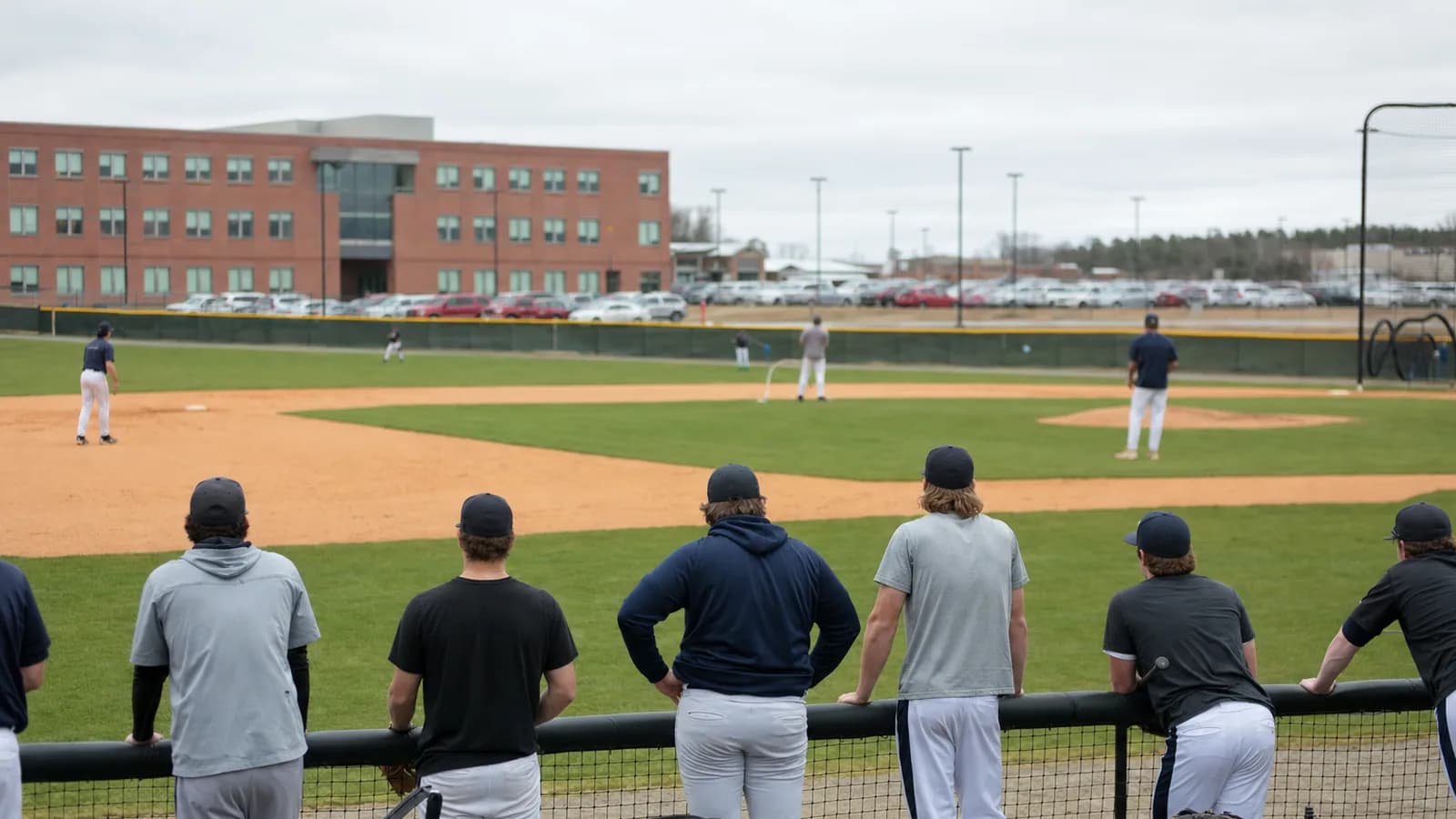
Image: AI-generated.
Junior college in 3 key points
Full athletic scholarship in NJCAA Division I
The NJCAA is the sports association of junior colleges. In its Division I, a team may pay tuition, fees, room, board and books. It may also pay one trip home a year. A Division II team may pay tuition, fees and books. A Division III team pays no athletic scholarship.
Two junior college years leave three NCAA years
The NCAA is the association most US universities and colleges belong to. It counts five years from your first full-time term at any university or college. Junior colleges count too. After two junior college years, you have three NCAA years left. You may have fewer if your 19th birthday started the count earlier.
Associate degree replaces the NCAA school standard
Maybe your school grades missed the NCAA standard. Division I still takes you with an associate degree from a junior college. You need transferable credit in English, mathematics and science. The four-year university or college must accept that credit. Your average must be at least 2.0.
Junior colleges award a two-year associate degree
A junior college is a two-year college in the US. Its programs end in an associate degree. The two kinds are the Associate of Arts and the Associate of Science.
EducationUSA is the US State Department's advice network for students from abroad. It calls the same kind of college a community college.
EducationUSA calls the next step the 2+2 model. You study two years at a community college. Then two years at a four-year university or college bring the bachelor's degree.
Many community colleges agree with universities and colleges in advance which credits transfer. Some guarantee a place once you hold the associate degree.
Junior college sport runs through the National Junior College Athletic Association, the NJCAA. It has more than 500 member colleges. It also has its own handbook, divisions and scholarship rules.
Most US universities and colleges belong to the NCAA. The NJCAA is separate from it and from the smaller NAIA.
Community college tuition averages US$4,210 for local residents
For 2026-27, public two-year colleges charged US$4,210 in tuition and fees on average. These figures come from the College Board.
A public four-year university or college charged students from other states US$32,730 on average. EducationUSA says community college fees are often less than half as high.
The US$4,210 is the in-district rate. A community college charges this rate to people who live in its own district.
As a student from abroad, you pay the out-of-district or international rate. Each community college publishes it on its website. Room, board, health insurance and flights cost extra.
You need a Form I-20 for your student visa. To get it, you prove you can pay tuition and living costs.
A merit scholarship is money for good grades. EducationUSA says many four-year universities and colleges offer them to community college transfers.
NJCAA Division I may pay a full scholarship
The NJCAA is the sports association of junior colleges. It sorts its teams into three divisions. Each junior college picks the division per sport.
The rules are in the NJCAA Handbook 2026-27. A Division I team may pay tuition, course fees, room, board and books. It may also pay one trip home a year.
A Division II team may pay tuition, course fees and books. Both divisions may add up to 250 US dollars yearly for required supplies. Division II pays no room, board or travel.
A Division III team gives no athletic scholarship.
Every NJCAA athletic scholarship comes as a Letter of Intent. It is a written agreement for one year. The year runs from August 1 to July 31.
The junior college must tell you its decision by June 15. It can renew, cut or end the award.
Without that notice, other NJCAA colleges may sign you from June 16.
Junior college years reduce your five NCAA years
The NCAA is the association most US universities and colleges belong to. It gives you five years to compete.
The Division I Manual starts the five years with your first full-time term. That term can be at any university or college, at home or abroad. Or the academic year after your 19th birthday starts them, if it comes first.
The NCAA counts terms at two-year colleges too. Division I adopted this age-based rule on 24 June 2026. Division II adopted it on 5 August 2026.
The five years run without a pause. So two junior college years leave you three NCAA years. One junior college year leaves you four.
The NJCAA counts seasons and allows two per sport, however long you study there. Any part of an official contest counts as a season.
If you enroll right after school, you can play two NJCAA seasons. Then you can play three NCAA seasons.
Two routes from junior college to Division I
Division I is the top level of the NCAA. It has two transfer routes, and the first one is for qualifiers.
A qualifier passed 16 core courses at school. The qualifier's average was at least 2.3. Core courses are the academic subjects the NCAA counts.
On June 24, 2026, the NCAA revised both routes. The new rules apply to certifications from fall 2026.
A qualifier may compete after one full-time semester or quarter at the junior college. Summer sessions do not count.
You need an average of at least 2.0 in transferable credit. That is credit a four-year university or college accepts.
Ask the compliance office of that university or college to check your courses early. This office checks NCAA rules.
Without qualifier status, you need the associate degree and transferable credit in three subjects. That means six semester hours of English and three of mathematics. Three more must be in natural or physical science.
Your overall average must reach at least 2.0. Then the associate degree replaces a school record below the NCAA standard.
Three routes from junior college to Division II
Division II is the second NCAA level. It offers three ways to compete right after a junior college.
The first route is the associate degree after at least two full-time semesters there. At least a quarter of its credit hours must come from that junior college.
A qualifier met the NCAA's academic standard at school. A qualifier needs 12 semester hours of transferable credit for each full-time term. The average must be at least 2.2.
This route works after one full-time term or after several. Division II counts everyone else as a partial qualifier.
A partial qualifier needs at least two full-time terms of 12 hours each. The average must be at least 2.2. They also need six hours of English, three of mathematics and three of science.
Without one of these routes, you wait a year before you compete. Bylaw 14.3.4.3.5 still lets you train and get athletic aid.
Division I takes 5.4 percent from junior colleges
NCAA Research is the NCAA's own research office. It looked at where the Division I athletes who started in 2020-21 came from. Of these athletes, 5.4 percent had transferred from a two-year college.
Among the men, the share was 7.9 percent. Among the women, it was 2.5 percent.
Baseball had the highest share with 21.0 percent. Men's basketball came next with 15.0 percent. Women's basketball led the women's sports with 9.0 percent.
Men's soccer had 4.4 percent, and men's tennis had 2.9 percent. Women's tennis had 1.6 percent. Swimming, rowing and lacrosse had less than 1 percent.
A coach takes less risk with a junior college transfer. The athlete brings two seasons of results in college sport. The athlete also brings a US transcript, the list of courses and grades.
Ask a coach how many current players came from a junior college.
3 cases where a junior college makes sense
A junior college makes sense in three cases. First, your school record misses the NCAA standard. Second, your level needs two more years for a Division I or II coach.
Third, your family cannot pay for a four-year university or college. An NJCAA Division I scholarship then covers most of the bill.
A junior college makes less sense with a Division I or II offer. You would trade two of your five NCAA years for lower fees. A later scholarship from a four-year university or college covers no junior college years.
In Europe, an associate degree seldom counts as a qualification of its own. So plan the bachelor's degree from the start.
Before you sign, ask the junior college two things in writing. First, ask which four-year universities and colleges took its graduates in your sport.
Ask this for the last two years. Second, ask which courses those universities and colleges accepted.
Direct NCAA start and junior college compared
Each row compares one point for an athlete from abroad starting right after school.
| Point | Straight to NCAA Division I or II | Junior college first, then Division I or II |
|---|---|---|
| NCAA years left on arrival | Five, or fewer if your 19th birthday started the count first | Three after two junior college years |
| Academic standard | Qualifier status from the NCAA Eligibility Center, with 16 core courses. Core average of 2.3 in Division I or 2.2 in Division II. | Transferable credit averaging 2.0 in Division I or 2.2 in Division II. Without qualifier status, Division I asks for the associate degree. |
| Athletic aid in years one and two | Set by the university or college within its division's rules | NJCAA Division I: up to tuition, room and board. Division II: tuition, fees and books. Division III: none. |
| Tuition in years one and two | Public four-year university or college, rate for other states: US$32,730 a year on average | Public two-year college, rate for local residents: US$4,210 a year on average. Each one sets its own international rate. |
| Seasons in years one and two | Two NCAA seasons | Two NJCAA seasons, the NJCAA maximum per sport |
| Degree after two years | None yet. The bachelor's degree takes 4 years. | Associate of Arts or Associate of Science |
Two junior college years can lower your fees and make up for weak grades. But they use up two of your five NCAA years.
Junior college: rules and application steps
The NCAA five-year rule sets your seasons left after a junior college. Your school grades decide your transfer route. Your budget decides which start works.
Rules with source and check date
Application steps with their dates
Common questions about athletic scholarships in the USA
How does a US community college differ from a four-year university or college?
What is a junior college in the United States?
How much does a community college cost in the United States?
Does a year at a junior college count against NCAA eligibility?
Can I transfer from a junior college to Division I without NCAA qualifier status?
Does the NJCAA give full athletic scholarships?
How many seasons can I play at a junior college?
Can international students play sport at a junior college in the USA?
More guides on athletic scholarships
Sources
Each figure comes from one of these sources. If no source reports a figure, we do not estimate one.
- NJCAA Handbook 2026-27, Bylaws, Article V Section 5 (seasons) and Article VI (scholarships, letters of intent) (11 November 2026)
- NJCAA, Compliance & Eligibility (11 November 2026)
- NCAA, 2026-27 Division I Manual, Bylaw 12.6 (five-year period) and Bylaw 14.5.4 (two-year college transfers) (11 November 2026)
- NCAA, 2026-27 Division II Manual, Bylaws 14.02.21 (qualifier and partial qualifier) and 14.3.4 (two-year college transfers, including 14.3.4.3.5) (11 November 2026)
- NCAA, Division I and Division II age-based eligibility rules (11 November 2026)
- NCAA Research, Transfer Composition of Division I Teams (July 2022) (11 November 2026)
- EducationUSA, Study in the United States with the 2+2 Model (11 November 2026)
- College Board, Trends in College Pricing 2026: Highlights (11 November 2026)
- NCAA, Division I adopts age-based eligibility model (20 October 2026)
- NCAA, Division II adopts age-based eligibility model (20 October 2026)
- NCAA, Initial-eligibility requirements (6 November 2026)
- NCAA, 2026-27 Guide to International Academic Standards for Athletics Eligibility (11 November 2026)
- NCAA Eligibility Center, registration (6 November 2026)
- NCAA, Division I Proposal 2026-40, Two-Year College and 4-2-4 Transfer Requirements (adopted 24 June 2026) (11 November 2026)
- NAIA, 2026-27 Official & Policy Handbook, Article V, Sections B (season, term of attendance), C (24/36-hour rule, junior college exception) and G (transfers) (11 November 2026)
- NAIA, NAIA Approves Fifth Year of Eligibility (4 November 2026) (11 November 2026)
The editorial team of Athletic Scholarships USA writes and checks every text and figure. We are not an agency and do not place athletes at universities and colleges. When an agency would serve you better, we say so.