NCAA Division II
Athletic scholarships in NCAA Division II
NCAA Division II, the second NCAA level, has 138,806 roster places. Applicants who write only to Division I miss all of these places.
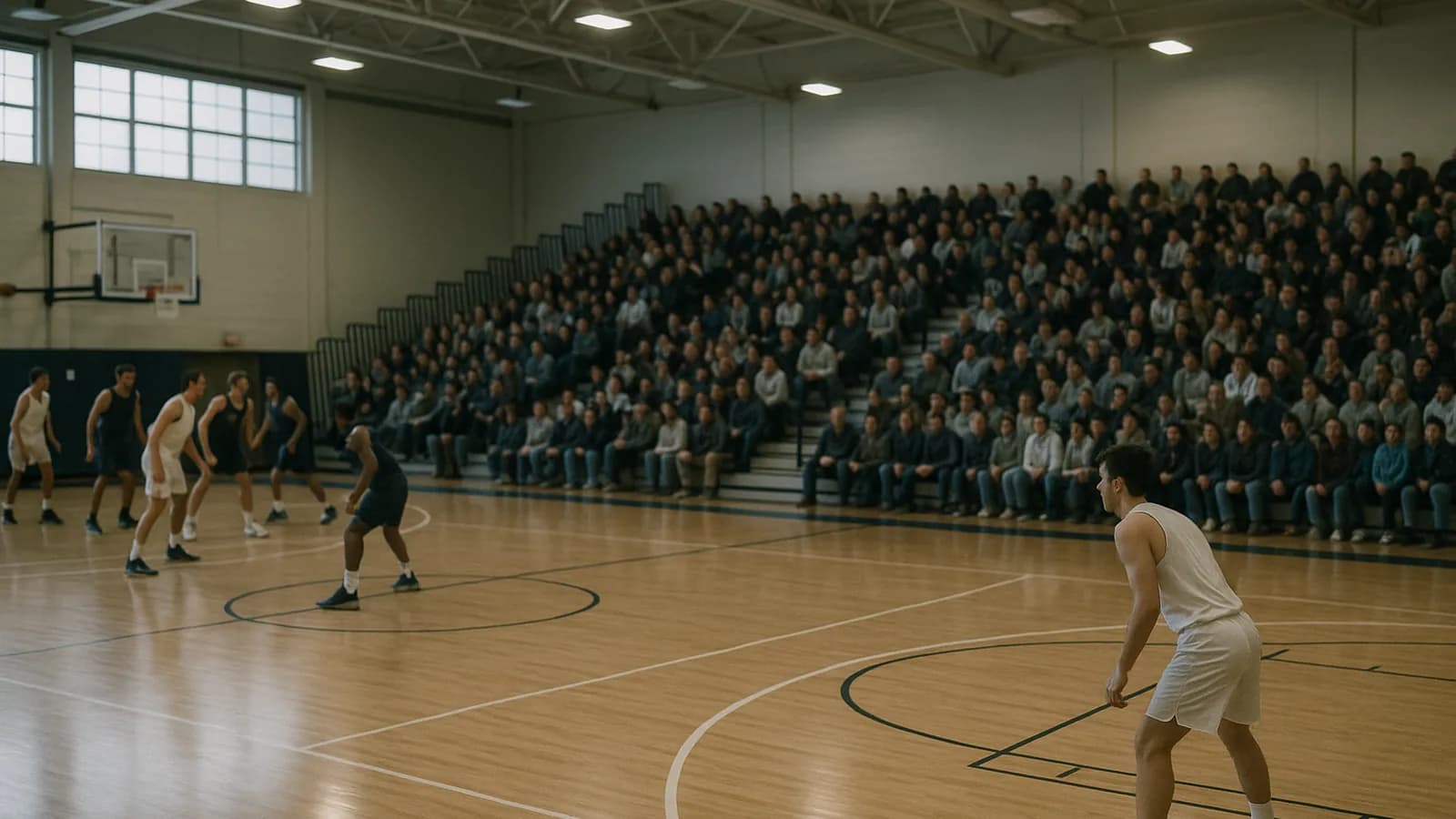
Image: AI-generated.
Roster limit, first contact and season for NCAA Division II
294
Colleges
2024-25
138,806
Roster places
34,702 New places a year
US$6,087
Per roster place
US$844.8M
21
Sports offered
47 States
NCAA Division II
Same approval, lower grade requirement
The NCAA Eligibility Center also approves you for Division II. It asks for the same 16 core courses as Division I. Core courses are the academic school subjects the NCAA counts. You need a lower grade point average than in Division I.
Partial scholarships are the rule
On average, Division II waives US$6,087 in fees per roster place. Full scholarships exist, but most athletes get a partial scholarship plus academic aid. Academic aid is money for good grades.
More playing time
Division II teams have smaller rosters and shorter trips. Many athletes compete in their first season. In Division I, they would often wait on the bench.
Many applications from abroad fail because the athlete wrote only to Division I.
Division II offers 138,806 roster places
Division II has 294 universities and colleges in the federal report. They have 138,806 roster places and report US$844.8M in athletic aid. They follow the same NCAA rulebook as Division I, with smaller budgets.
An average Division II university or college spends US$62,008 a year on recruiting. Smaller budgets make Division II coaches search less and react more to athletes' emails. They read a good email from an applicant abroad to the end.
The NCAA asks Division II to give sport, study and campus life equal weight. That means fewer games during the week and shorter trips. You also miss fewer classes.
Lower grade requirement than in Division I
Both NCAA divisions ask for 16 core courses. Core courses are the academic school subjects the NCAA counts.
Division II wants a lower grade point average in these courses than Division I. This difference decides many applications from abroad.
The NCAA converts your school grades itself, with its own guide for each country. Your school has no say in it. Grades that look solid at home may only just pass after the conversion.
Apply to Division II as well as to Division I. You need the same documents and the same NCAA approval. But you have more room on the grade requirement.
No roster limits in Division II
The House settlement brought roster limits and revenue sharing to Division I only. Revenue sharing means direct payments from a university or college to its athletes. Division II still limits the number of scholarships per sport.
So the rules for your application stay stable. What a Division II coach tells you in the fall still applies in spring.
Requirements for NCAA Division II
The requirements of NCAA Division II cover core courses, grade average and tests. They also cover approval, athletic aid and competition years.
| Core courses | 16 recognized core courses |
|---|---|
| Grade average | 2.2 average in core courses |
| SAT or ACT | not required |
| Checked by | NCAA Eligibility Center |
| Athletic aid | full and partial scholarships |
| Time limit for competing | five years from first enrollment or age 19 |
Division II waives US$6,087 per roster place
Division II reports US$844.8M in athletic aid for 138,806 roster places. That comes to US$6,087 per roster place.
Division II pays less per roster place than Division I. It also pays less than the NAIA, which gives US$8,329.
The scholarship amount alone does not tell you what you pay. Take a partial scholarship at a cheap state university or college. It may cost you less than a larger scholarship at an expensive private one.
Always work out the amount left on your bill after the scholarship. That amount is what you or your family pay each year.
Subgroups of universities and colleges in NCAA Division II
The federal report sorts the members of NCAA Division II into these subgroups. The counts show why this number can differ from the association's member count.
| Association and division | Colleges |
|---|---|
| NCAA Division II with football | 156 |
| NCAA Division II without football | 138 |
Teams and roster places by sport in NCAA Division II
| Sport | Men | Women | ||||
|---|---|---|---|---|---|---|
| Teams | Roster places | Average squad size | Teams | Roster places | Average squad size | |
| Basketball | 292 | 5,536 | 19.0 | 293 | 4,853 | 16.6 |
| Cross country | 273 | 4,277 | 15.7 | 294 | 3,839 | 13.1 |
| Track and field | 262 | 18,061 | 68.9 | 281 | 16,006 | 57.0 |
| Soccer | 206 | 7,893 | 38.3 | 256 | 8,261 | 32.3 |
| Golf | 201 | 2,327 | 11.6 | 187 | 1,578 | 8.4 |
| Tennis | 144 | 1,572 | 10.9 | 196 | 1,830 | 9.3 |
| Volleyball | 40 | 769 | 19.2 | 282 | 5,460 | 19.4 |
| Softball | 0 | 0 | - | 271 | 6,355 | 23.5 |
| Baseball | 254 | 12,009 | 47.3 | 0 | 0 | - |
| Lacrosse | 77 | 3,451 | 44.8 | 110 | 2,993 | 27.2 |
| Swimming | 78 | 1,778 | 22.8 | 97 | 2,121 | 21.9 |
| Wrestling | 77 | 2,618 | 34.0 | 34 | 788 | 23.2 |
| Bowling | 7 | 121 | 17.3 | 37 | 353 | 9.5 |
| Field hockey | 0 | 0 | - | 34 | 871 | 25.6 |
| Ice hockey | 19 | 555 | 29.2 | 10 | 255 | 25.5 |
| Beach volleyball | 0 | 0 | - | 24 | 424 | 17.7 |
| Rowing | 3 | 76 | 25.3 | 14 | 322 | 23.0 |
| Gymnastics | 0 | 0 | - | 15 | 431 | 28.7 |
| Water polo | 6 | 133 | 22.2 | 8 | 162 | 20.2 |
| Skiing | 6 | 68 | 11.3 | 6 | 68 | 11.3 |
| Fencing | 1 | 16 | 16.0 | 1 | 9 | 9.0 |
Universities and colleges in NCAA Division II with the highest aid per roster place
The universities and colleges appear in order of fees waived per roster place. The federal report gives it per university or college and gender, never per sport.
| University or college | State | Roster places | Fees waived per roster place |
|---|---|---|---|
| Union University | TN | 207 | US$17,895 |
| Eckerd College | FL | 236 | US$16,706 |
| North Greenville University | SC | 602 | US$15,158 |
| Point Loma Nazarene University | CA | 228 | US$14,927 |
| St. Mary's University | TX | 237 | US$14,728 |
| Saint Edward's University | TX | 285 | US$13,761 |
| Auburn University at Montgomery | AL | 209 | US$13,718 |
| University of the District of Columbia | DC | 138 | US$13,638 |
| Nova Southeastern University | FL | 334 | US$13,636 |
| Thomas Jefferson University | PA | 309 | US$13,341 |
Who NCAA Division II suits and who it does not
Athletes who fit Division II
- Division II suits athletes who are close to Division I level. They may not reach the higher grade requirement of Division I.
- Division II suits athletes who value playing time more than a famous name.
- Division II suits students in bachelor's programs with fixed class hours. Trips are shorter, so you miss fewer classes.
Athletes who do not fit Division II
- Division II does not suit athletes who want a pro career in some sports. In those sports, pro scouts watch only Division I.
- Division II does not suit athletes who can only come with a full scholarship. Full scholarships exist in Division II, but they are rare.
Common questions about athletic scholarships in the USA
Is the sporting level in NCAA Division II lower than in Division I?
Do I need the NCAA Eligibility Center for Division II?
How much athletic aid does a Division II athlete get?
Can I move from Division II to Division I later?
Rules for your athletic scholarship in the USA
College sport divisions in the USANCAA
Sources
Each figure comes from one of these sources. If no source reports a figure, we do not estimate one.
- U.S. Department of Education, Equity in Athletics Data Analysis (EADA) (22 August 2026)
- NCAA, Division II (21 August 2026)
- NCAA, Division II member schools (21 August 2026)
- NCAA, Initial-eligibility requirements (21 August 2026)
The editorial team of Athletic Scholarships USA writes and checks every text and figure. We are not an agency and do not place athletes at universities and colleges. When an agency would serve you better, we say so.